Exponent Calculator
Need to solve exponents or roots fast? Our Exponent Calculator makes it easy! Whether you're calculating squares, cubes, or complex powers, get accurate results instantly. Just enter the base and exponent.
Share Calculator


Common Calculators | |
Table of Contents
- 1. Some Important Exponent Formulas
- 2. Exponent Formulas
- 3. How to Calculate Exponents
- 4. Some Important Exponent Formulas
- 5. Utilizing exponents in real-world applications
- 6. What is Exponent Calculator
- 7. 2 to the power of 6
- 8. Exponent calculator with variables
- 9. Solve for exponent calculator
- 10. Negative and fractional exponents
- 11. FAQ
Some Important Exponent Formulas
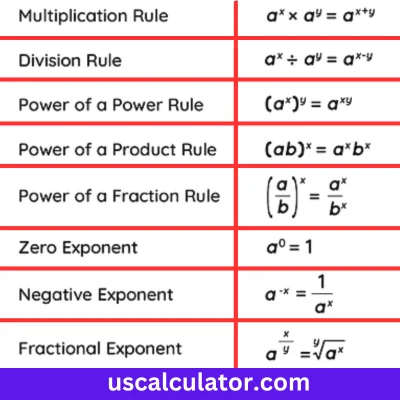
Exponent Formulas
Now we will learn how to calculate an exponent using an exponent calculation formula. Here are some of the common exponent formulas that you can use to simplify and solve exponent problems. Formulas are given below.
Multiplication of exponents with the same base: xm ⋅ xm = xm + n
Division of exponents with the same base: xm ÷ xn = xm - n (where m≥n)
Power of a power: (xm) n = xm⋅n
Exponent of 1: x1 = x (any number except for zero)
Exponent of 0: x0 = 1 (where x = 0 )
Negative exponents: x-n = xn
How to Calculate Exponents
We shall now study exponent calculation. Exponentiation for positive integer exponents is multiplying the base by itself n times. For instance, 5³ equals 5 × 5 × 5, or 125. We will now comprehend the step-by-step process of calculating exponents. The steps to compute exponents are as follows:
Determine the base and exponent of the expression.
The base should be multiplied by itself n times, where n is the exponent if the exponent is positive.
If the exponent is negative, increase the base to the exponent's absolute value by reciprocating the base—that is, dividing 1 by the base.
Remember that anything to the power of one is just itself (x¹ = x) and that there are exceptional circumstances for 0 exponents, such as x⁰ = 1 (where x ≠ 0).
Exponent Calculator: Our calculator's goal is to simplify your life. Input the values and weights, and the calculator will quickly compute the Power.
Some Important Exponent Formulas
Basic Exponent Rules
Product of Powers Rule:
am × an = am + n
When multiplying two exponents with the same base, add the exponents.
Quotient of Powers Rule:
| = am - n (for a ≠ 0) |
When dividing two exponents with the same base, subtract the exponents.
Power of a Power Rule:
(am)n = am × n
When raising an exponent to another exponent, multiply the exponents.
Power of a Product Rule:
(ab)n = an × bn
When raising a product to an exponent, raise each factor to the exponent.
Power of a Quotient Rule:
| ( |
|
)n = |
|
(for b ≠ 0) |
When raising a quotient to an exponent, raise both the numerator and the denominator to the exponent.
Practical Examples
Simplifying Expressions:
23 × 22 = 23 + 2 = 25 = 32
Evaluating Negative Exponents:
| 5-2 = |
|
= |
|
Working with Fractional Exponents:
Utilizing exponents in real-world applications
Exponentiation finds applications in computer science, biology (population growth is frequently exponential), chemistry, physics, and economics (compound interest, for example). In computer science, storage capacity units are conventionally based on powers of two, and public-key cryptography functions depend on the hard reversibility. Those who work in these fields frequently find themselves utilizing an exponential calculator.
In physics, exponential decay applies to radiation, dangerous materials, light, sound, and gravity (see radioactive decay and half-life). We discuss marketing and the spread of ideas, memes, viral videos, etc., in terms of exponentially increasing reach. Moore's law, which charts the increase in processing power, is essentially exponential. The scale used to measure earthquakes is exponential as well.
The magnitude 5 of an earthquake is thus 32 times greater than that of a magnitude 4 earthquake (101.5), whereas a magnitude 6 earthquake releases 1,000 times more energy (103) than a magnitude 4 earthquake. Since the decibel scale used to measure loudness is also exponential—20 dB = 102 dB = 100 power ratio, and 30 dB = 103 = 1,000 power ratio—a 30 dB sound level is ten times louder than a 20 dB sound level.
If you calculate Exponent (Power) based on the Exponent (Power) calculation formula but have doubts, use our Exponent calculator to double-check the findings if you're unsure.
What is Exponent Calculator
The Exponent Calculator is a straightforward tool for calculating the Exponent (Power). Entering the base number and the number is required. It displays the answer in Exponent (Power), which makes calculating the Exponent (Power) easier.
The Exponent Calculator primarily aims to simplify Exponent (Power) calculations. Whether you operate as an engineer, businessperson, student, or in another field, it is useful for calculating the Exponent (Power). In this manner, you can save time and choose the best solutions.
2 to the power of 6
The base is 2 and the exponent is 6.
Answer: 64.
Stepwise computation: 2 to the power of 1 = 2 followed by 2 to the power of 2 = 4 then next step is 2 to the power of 3 = 8 so next is 2 to the power 4 = 16 continuing further with 2 to the power of 5 = 32 lastly 2 raised to the power of 6 = 64.
Step expansion: 2¹ = 2 → 2² = 4 → 2³ = 8 → 2⁴ = 16 → 2⁵ = 32 → 2⁶ = 64.
The significance of this process is that it works excellently when performing mental calculations to demonstrate the mechanism of exponential increase.
Exponent calculator with variables
If you were to calculate 3 raised to the power of x, where x = 4. The input will be putting the number 3 and its value 4, then the result would be 81.
If the formula is complicated for example (2 y) raised to the power of 3, where y = 5, the calculator first performs (10) raised to the power of 3, equaling 1000, and can show how it accomplished that.
Variables provide advanced understanding in algebra assignments calculations or testing formulas and make things even quicker.
Solve for exponent calculator
Solving Exponents
Given that 5 raised to the power x equals 625 and the need to find the value of x, enter the base value of 5 and the result of 625 into the calculator. The answer will be given as x equals 4 and may also appear on your calculator as:
x = log(625)/log (5) = 4..
Another case that one comes across could be the example of 2 raised to the power of x which equals 128 and therefore x equals 7. Realizing that log step raises the confidence level that the answer is knownity- meaning that no magic is involved and the answer can be found simply through the definition of logarithms.
Negative and fractional exponents
(-3)^4 = 81 (it is even exponent so the answer is positive).
8^(1/3)=2 (which is a cube root).
A good calculator does the job without making mistakes in signs or during the root extraction process which is otherwise known to be a source of many errors that people do during manual calculations.
FAQ
1. What is the value for 2 raised to the power of 6?
The answer is 2⁶ = 64, which means that 2 is multiplied six times.
2. Can a calculator that calculates exponentials work with algebraic variables?
There is a good number of tools that work with algebraic variables nd perform calculations after their numerical values are entered or keep them as is for further operations with this expression.
3. What can you do to find an unknown exponent?
The input for the calculator will be the base and the result, after which you will receive the exponent and probably all the steps leading to this result.
4. Does a calculator give you step-by-step instructions?
High-quality tools always show expansion when calculating integer exponents or taking logarithms to find the unknown exponent. Make sure you select “show steps” or “detailed solution” options.
5. Can online calculators that solve exponentials be trusted when it comes to the large numbers?
Reputable calculators use precise calculations and scientific notation, so their results are much more reliable than those obtained during manual calculation.