Trigonometry Calculator
Struggling with trigonometry? Or the Trigonometry Calculator makes solving angles and radians! Calculate sine, cosine, tangent, and other functions instantly.
Share Calculator


Related Calculators | |
Table of Contents
- 1. About Trigonometry
- 2. How to Use the Trigonometry Calculator
- 3. The Functions of a Trigonometry Calculator
- 4. Trigonometry Fundamentals You Should be Aware Of
- 5. Basic trigonometric formulas and identities
- 6. Trigonometry Class 10 Tips for Study
- 7. Core Trigonometry Ratios Every Student Must Know
- 8. Essential Trigonometry Formulas & Cheat Sheet
- 9. Table of Trigonometry (Cheat Sheet)
- 10. Step-by-Step Trigonometry Class 10 Questions Solved
- 11. Problem 2: Proving a Trigonometric Identity
- 12. FAQ
About Trigonometry
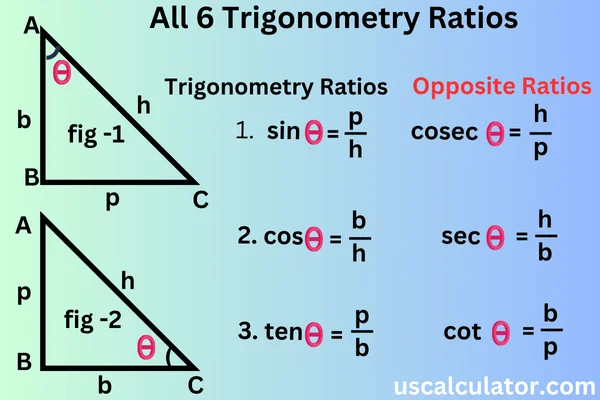
What is this right-angled triangle? A triangle in which one angle is 90 degrees and the other two angles are smaller than 90 degrees is called a right-angled triangle.
The side in front of 90 degrees will be the side with the longest length of this triangle, which we call the hypotenuse. There are three angles in a triangle; now, we have shown B as 90 degrees. Now, this triangle also has an unknown angle when we look at it in relative terms. Now, the two unknown angles in the triangle are A and C. You can either take the unknown angle at angle C or angle A. The unknown angle is identified by the name of theta. Theta represents the unknown angle. The side in front of 90 degrees is the hypotenuse; similarly, this unknown angle is represented by theta. The side in front of the theta will always be perpendicular. The side on which the whole triangle rests is called the base. You will have to remember this. A right-angled triangle is formed by the three sides: the perpendicular, hypotenuse, and base.
How to Use the Trigonometry Calculator
Values entered: Enter the desired side or angle value to be calculated.
Select Function: Select the desired trigonometric function (such as the tangent, sine, or cosine).
Obtain outcomes: The trigonometric value corresponding to that will be shown on the calculator.
For instance, the sine of thirty degrees would be found by:
Enter: 30
Choose: sine; Outcome: 0.5
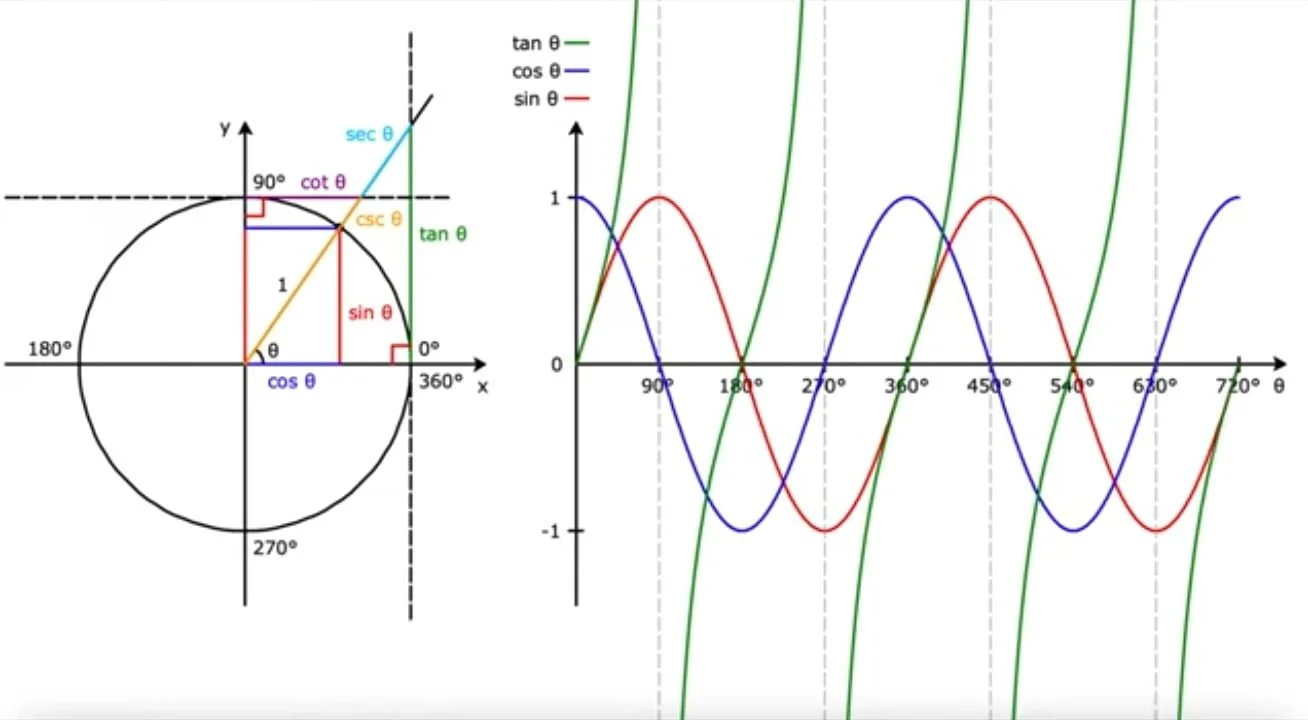
Trigonometry Functions
The Functions of a Trigonometry Calculator
A trigonometry calculator is more than just a tool for calculating sin, cos and tan. It has a big potential in finding the unknown sides or angles and in checking if your calculations are correct. This is why it is considered to be extremely useful when studying in school, double-checking homework, or doing some quick revision of the material.
In general case, all people who use this calculator are looking for one of these:
Trig function values such as sine, cosine, and tangent.
Unknown sides or angles in a trigonometry triangle.
A way to test trigonometry identities and simplify expressions.
It is particularly useful for students doing trigonometry problems because students are able to see why their steps are correct.
Benefits to students in an actual study / Why does it help in practical studies
Calculator does not substitute your knowledge but lessens unrealistic guessing. For example, if one knows that sin θ = opposite/hypotenuse, calculator will tell the right number for the required degree of angle, enabling the student to solve exercises more quickly.
Trigonometry Fundamentals You Should be Aware Of
Trigonometry approaches the angles and sides of the triangle, that is the principle behind all ratios and formulas related to trigonometry.
Six basic ratios are:
sin θ = opposite / hypotenuse
cos θ = adjacent / hypotenuse
tan θ = opposite / adjacent
cosec θ = hypotenuse / opposite
sec θ = hypotenuse / adjacent
cot θ = adjacent / opposite
These ratios are primarily the basis for most chapters of trigonometry in class 10. According to NCERT style, students start with definitions, and after that proceed to identities and problem-solving.
The important triangle concept
If you remember only one thing from trigonometry, remember that it is based on the right triangle. After determining the opposite side, adjacent side, and hypotenuse, it will become easy to solve the main problems.
Basic trigonometric formulas and identities
Using a calculator is helpful, but formulas still count because examinations generally ask students to show their steps instead of providing mere final answers. Some of the most important identities are likely to include the reciprocal, ratio, and Pythagorean identities. These identities are also the most common used for simplifying algebraic expressions.
Basic formulas
sin²θ + cos²θ = 1
1 + tan²θ = sec²θ
1 + cot²θ = csc²θ
tan θ = sin θ / cos θ
cot θ = cos θ / sin θ
These are core formulas that each student should have copied on a one-page Trig PDF or reference sheet. Formula sheets and cheatsheets are still popular because they enable learners to quickly review the framework of the subject before sitting test revisions.
A look into the trigonometry identities
The identities of trigonometry would become more relevant when one needs to prove that two expressions are equal. That is where algebraic manipulation comes in. A calculator may preclude you from determining the equality of the two given expressions, but the proof still comes down to what it does in the algebraic sense.
Some common examples are:
sin²θ = 1 - cos²θ
cos²θ = 1 - sin²θ
sec²θ - tan²θ = 1
For students this is where mistakes often occur - they know the formula and yet make use of the wrong identity in the wrong step. Quick check in the calculator may save them time, yet learning the pattern of identities leads to true confidence in their own knowledge.
Mistakes you should avoid include:
Using radians when the question expects degrees.; being confused about the terms opposite and adjacent; misstating the brackets; thinking that the calculator can do something by itself. If you have a learning section on your site, it will be wise to link it to a radian and degrees guide, a right triangle explanation, and a page with formulas.
Trigonometry Class 10 Tips for Study
The best way to approach learning trigonometry class 10 is to first learn the ratios followed by practicing identities then mixed questions. Students typically try to memorize too much at once which makes the chapter more complex even when the ideas are simple.
Steps to start with
The six trigonometric ratios
The basic angles like 0°, 30°, 45°, 60°, 90°
Basic identities and their reciprocals
Solving simple questions of right triangles.
This is in the order of the progress because each concept supports the other concept. Once students learn the ratios, it becomes easier for them to grasp the identity concepts.
An effective studying technique
This involves practicing the process of doing a question manually and then using a calculator to check the answer. The idea behind this habit is to help students achieve accuracy without becoming dependent on calculators. Completing this process allows students to know whether the loss of marks is due to errors in concept or merely calculation errors.
Core Trigonometry Ratios Every Student Must Know
To get the most out of any tool, you need to understand the basic relationships within a trigonometry triangle (specifically, a right-angled triangle).
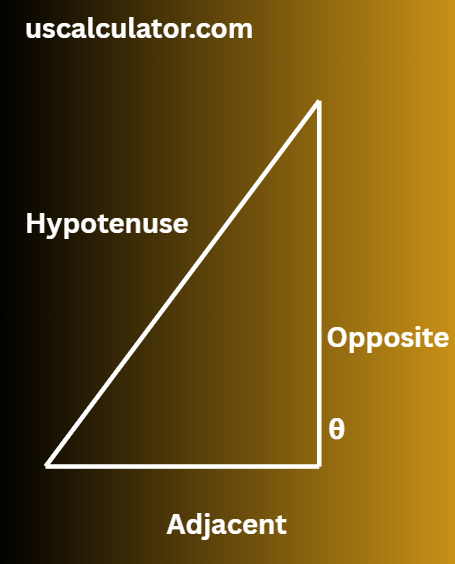
Given a right-angled triangle with an acute angle θ:
Hypotenuse: The longest side, directly opposite the 90° right angle.
Opposite: The side across from the angle θ.
Adjacent: The side next to the angle θ (that is not the hypotenuse).
1. The Primary Trigonometric Ratios (SOH CAH TOA)
2. The Reciprocal Ratios
Essential Trigonometry Formulas & Cheat Sheet
Having a quick reference guide helps when setting up problems before plugging numbers into a calculator.
Fundamental Trigonometry Identities
Table of Trigonometry (Cheat Sheet)
| Angles (In Degrees) | 0° | 30° | 45° | 60° | 90° | 180° | 270° | 360° |
|---|---|---|---|---|---|---|---|---|
| Angles (In Radians) | 0 | π/6 | π/4 | π/3 | π/2 | π | 3π/2 | 2π |
| sin | 0 | 1/2 | 1/√2 | √3/2 | 1 | 0 | -1 | 0 |
| cos | 1 | √3/2 | 1/√2 | 1/2 | 0 | -1 | 0 | 1 |
| tan | 0 | 1/√3 | 1 | √3 | ∞ | 0 | ∞ | 0 |
| cot | ∞ | √3 | 1 | 1/√3 | 0 | ∞ | 0 | ∞ |
| cosec | ∞ | 2 | √2 | 2/√3 | 1 | ∞ | -1 | ∞ |
| sec | 1 | 2/√3 | √2 | 2 | ∞ | -1 | ∞ | 1 |
Step-by-Step Trigonometry Class 10 Questions Solved
Let's walk through two typical Trigonometry Class 10 problems so you can see how to set up calculations manually and verify them using a tool.
Problem 1: Finding a Missing Side Length
Question: A right triangle has an angle of 30° and an adjacent side length of 10 cm. What is the length of the opposite side?
1. Identify the given values:
Angle (θ) = 30°
Adjacent = 10 cm
Opposite = x (unknown)
2. Select the correct ratio:
3. Set up the equation:
4. Substitute known values and solve:
5. Verify with a calculator: Enter Angle = 30° and Adjacent = 10. The calculator confirms the opposite side is approximately 5.77 cm.
Problem 2: Proving a Trigonometric Identity
FAQ
What is the best way to master trigonometry?
A good starting point is to study basics involving the right triangle along with the six main ratios. After that is straight forward to learn identities and normal angles. Practicing little by little on a daily basis is more efficient than trying to study in a short time.
Can the calculator be used to solve trigonometric problems?
Indeed, the high number of common calculators and internet programs can perform this task. Nevertheless, having an idea what the ratio is needed is still important.
What are the trigonometric identities students should know for Class 10?
The basic identities include sin²θ + cos²θ = 1, 1 + tan²θ = sec²θ, and 1 + cot²θ = csc²θ.
Is using a trigonometry PDF while revising helpful?
Absolutely, a well-organized trigonometry PDF with formulas, formulas, identities and relevant values is one of the quickest methods to revise for your test. This method works particularly well if combined with practice questions.
What is the reason of my errors in trigonometry?
The main reason for errors in solving trigonometry problems is confusing sides of triangles, using wrong angle mode or forgetting about labels on the diagram. A simple triangle sketch and double-checking with calculator usually solve the problem immediately.