Free Margin Calculator
Set winning prices with our free Margin Calculator! Instantly find your gross or net profit margins by entering costs and revenue.
Stock Trading Margin Calculator
Stock price is just the price for one share. Number of shares is how many you plan to buy. Margin requirement means the percentage your broker expects you to put up for a margin purchase. Amount required tells you the smallest balance you need in your account to make that purchase happen.
Currency Exchange Margin Calculator
Exchange rate shows you how your home currency stacks up against the one you want to buy. Say you want 100 EUR and you work in USD; if 1 EUR costs 1.22 USD, your exchange rate is 1.22. Margin ratio is just the portion of margin you use. Units are how much of the currency you’re buying. Amount required is what you need in your home currency to pull off the purchase.
Share Calculator


Business Calculators | |
Table of Contents
What is Margin?
Financial ratios are vital in the analysis of any company. With the help of financial ratios, we can easily compare companies. On this page, we will learn about one such important financial ratio, the net profit margin. We will know what a net profit margin a net profit margin is, how it is calculated, and how we should use it.
Let us understand what a net profit margin is. Net profit margin is a financial ratio that tells us how much net profit a company is making on its revenue, and we often show it in percentages. For example, if the net profit margin of a company is 15%, then it means that this company is making a profit of 15% on its total revenue. For example, if the revenue of the company is $100,000, then if the company is making a profit of 15% on it, the company is making a net profit of $15,000.
The formula to calculate profit margin is net profit margin = net income/revenue × 100. Here, net income, or what is also called net profit, is the company's profit for the whole year, while revenue means the total amount of products or services sold by the company in a year, we get both of these things, net income and revenue, from the company's income statement.
For example, let us assume AB Limited is a company whose income statement is something like this. Now, let us calculate the net profit margin of AB Limited. The formula for net profit margin is net profit margin = net income/revenue × 100. Here, the net income of AB Limited is $4,200,000, and the total revenue is $250,000,000. Thus, the net profit margin of AB Limited will be $4,200,000 divided by $2,500,000,000 × 100 = 16.80 percent. It means that AB Limited is making a net profit of 16.80 percent of its total revenue, or, in other words, AB Limited is converting 16.80 percent of its total revenue into profit. Net profit margin is generally used to compare companies within an industry.
Formula and calculation example for Gross Profit Margin
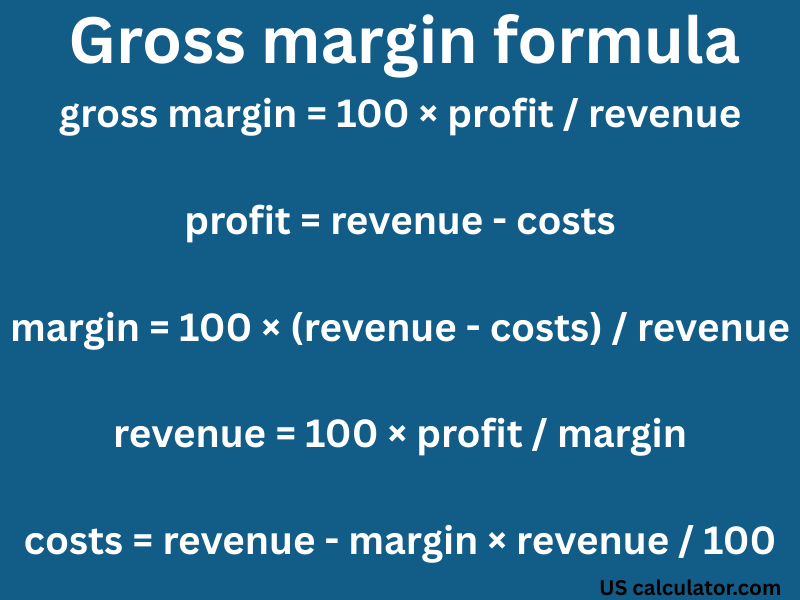
Margin is expressed as a percentage and is calculated using the following formula:
| Gross Profit Margin = ( |
| ) ×100 |
| Gross Profit Margin = ( |
| ) ×100 |
Here's a Description of the components -
Revenue - The total income generated from sales or services.
Cost of Goods Sold (COGS): All direct expenses (labour, materials, etc.) incurred in the production of goods or services.
For instance, the gross profit margin for a business with $100,000 in revenue and $60,000 in COGS would be -
| Gross Profit Margin = ( |
| ) ×100 = 40% |
This indicates that after deducting the direct expenses incurred in providing the goods or services, 40% of the income is held as gross profit.
Gross Margin Percentage:
((Selling Price – Cost Price) / Selling Price) × 100
Profit Margin (as a percentage of revenue):
Profit Margin = (Net Profit ÷ Revenue) × 100
Profit Percentage (often relative to cost):
Profit Percentage = (Profit ÷ Cost Price) × 100
Gross Profit:
Gross Profit = Revenue – Cost of Goods Sold
Net Profit:
Net Profit = Gross Profit – Operating Expenses – Taxes – Interest
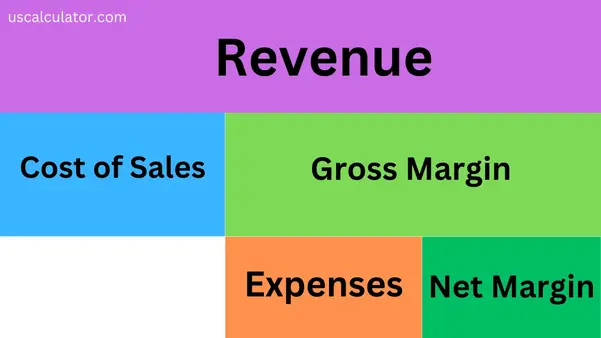
Formula and calculation example for Net Profit Margin
Using the following formula:
| Net Profit Margin = ( |
| ) ×100 |
For example, if a company has $100,000 in revenue and $20,000 in net profit, the Net Profit Margin would be -
| Net Profit Margin = ( |
| ) ×100 = 20% |
This means that 20% of the revenue is hold in as net profit after accounting for all expenses.
FAQ
1. What is the distinction between profit margin and profit percentage?
Profit margin is usually indicated according to the total revenue (total sales). Instead, profit percentage is usually in relation to cost. Both can be beneficial; just make sure to keep them straight.
2. How can I figure out the profit margin for different products?
Determine each product’s contribution on its own and then combine the results using revenue share or, alternatively, prepare the complete profit-and-loss statement for the period. Monthly profit calculator gives correct data for the whole period.
3. Can I use the same margin calculator with foreign exchange trading and cryptocurrencies?
While the mathematical calculations are the same, you will need to factor in particular expenses associated with each platform (spreads, overnight financing, blockchain fees, slippage). However, there are tools that tell you to add these expenses.
4. What makes the calculated margin different from the online tool?
You need to find out if the tool operates with gross or net numbers, whether it includes or excludes taxes, and if rounding or currency conversion has been done. You need to provide identical figures to ensure that there are no differences.
5. Is the better margin always the best?
No, it is not guaranteed that the higher margin is always better. Very high margins may mean that something is wrong and the company is not investing enough into customer service, growing, or warehouses. Healthy margins are somewhere in the middle, meaning that costs are covered, risks are rewarded, and competition is still possible.