Return on Equity Calculator (ROE)
Wondering how well your equity drives profits? Our free Return on Equity Calculator (ROE) reveals your financial efficiency instantly. Just input net income and shareholder equity, and get your ROE percentage in seconds. Smarter investing starts!
Share Calculator


Business Calculators | |
Table of Contents
- 1. Return on Equity Calculator (ROE): Formula, Calculation, Examples, and Interpretation
- 2. What is Return on Equity (ROE)
- 3. Five important points of this ratio (ROE)
- 4. Return on Equity Calculation Formula
- 5. Return on Equity Calculation Example
- 6. What Is a Good ROE?
- 7. Return on Equity vs. Return on Capital Employed (ROCE)
- 8. What Are the Limitations of Return on Equity?
- 9. Frequently Asked Questions (FAQs)
Return on Equity Calculator (ROE): Formula, Calculation, Examples, and Interpretation
Return on Equity, or ROE, measures how well a company uses its shareholders' money to make a profit. It's a go-to ratio for anyone looking to judge a business's performance—students, investors, business owners, or finance pros alike. ROE tells you, in simple terms, if a company is making good use of its equity. In this guide, we'll break down what ROE means, how to calculate it, what different results say about a business, how it stacks up against ROCE, its limitations, and walk through some real examples. Plus, you'll learn how to use the free ROE calculator.
What is Return on Equity (ROE)
You want to know about a parameter that will help you know about the leaders and strugglers of an industry. You can realize how the management of this company is and also how beneficial the company is. So today we will tell you about Return on Equity (ROE)
Suppose you and your friend started a company by contributing $1000 and $1000, and after one year, the company made a profit of $400, then your return and equity become $400, which is your profit earned divided by $2000 which you invested as equity in the company in the beginning, which means ROE is 20%. The higher this percentage number is, the better it is.
So now in the calculation of finance, the formula of ROE is Net Income divided by Average Shareholders' Equity. Here, net income means the after-tax profit of the company, and for shareholder equity, we will take the average of the beginning and end of the financial year because shareholder equity may change due to buybacks and dividend payments. Why is the ratio important? This ratio will give you an insider's insight to know about the business health of a company and also to know its efficiency as an investment. This ratio helps you in supporting such a company that can easily grow your investment.
For example, let's look at a company in the IT sector. Here in the ratio segment, the ROE of this company is 47.26% in March 2023, meaning that on every $100 of shareholder equity, the company earns a net profit of $47.26. Considering the IT sector, this is a good increase ascending the number. Let's know the five important points of this ratio.
Five important points of this ratio (ROE)
1. This ratio should also be compared with the company's peers and other industry players because in industries with high profit margins, like FMCG and pharmaceuticals, this number is generally higher, whereas in capital-intensive businesses like airlines, utilities, or real estate, the number is commonly lower.
2. The company can manipulate ROE by using debt. Hence, along with ROE, you should also look at other leverage ratios like debt-to-equity ratios or interest coverage ratios so that you can get a complete idea of the business.
3. This ratio should be looked at not only for one point three times but also for a long-term series. If the ROE is continuously increasing, it means that the company is utilizing its equity very well, whereas if the ROE is decreasing, it means that the management is investing the equity in unproductive assets.
4. As for investing, you should also look at the retained earnings of a company. Retained earnings mean that after deducting all the expenses, taxes, dividends, etc., whatever money is left is called written earnings. Therefore, if we look at the written earnings of a company for one year and the next year, the ROI of this company is seen increasing, which means that the company has generated new profit by using those written earnings for good projects.
5. Now, you may ask what the difference is between ROCE and ROE. So in ROCE, we consider both the debt and equity of the company, whereas in ROE, only the equity is considered. On the other hand, the earnings we see in ROCE are earnings before interest and tax, whereas in ROE, we only look at the net income. So, in summary, ROE tells us how well a company is generating a profit by utilizing its equity. But, by just looking at ROE, we cannot make our decision about which company to invest in because ROE does not tell us anything about the debt.
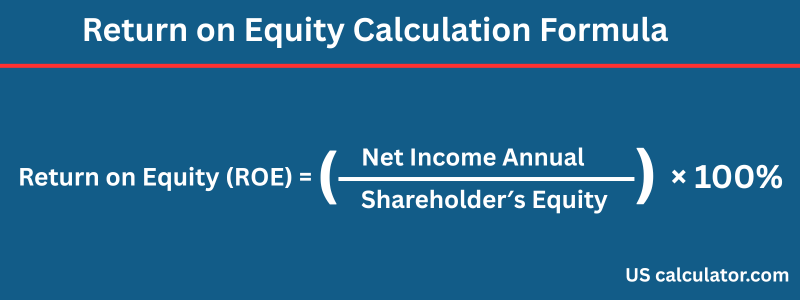
Return on Equity Calculation Formula:
The Return on Equity (ROE) is calculated using the following formula:
| Return on Equity (ROE): = ( |
| ) × 100 |
| Average Shareholders' Equity = |
|
Return on Equity Calculation Example
Here we will calculate Return on Equity based on the formula given above. For instance, if a company has a net income of $500,000 and shareholder's equity of $2,000,000, the ROE would be:
| ROE = ( |
| ) × 100% = 25% |
Return on Equity = 25%
Example 1: Basic ROE Calculation Using Average Equity
Let's understand Return on Equity (ROE) with a simple example.
ROE tells us how much profit a company earns using the money invested by its shareholders. To calculate it accurately, we use the average shareholders' equity because a company's equity can change during the year.
Given Information- Net Income = $10,000, Beginning Shareholders' Equity = $40,000, Ending Shareholders' Equity = $60,000
Step 1: Find Average Shareholders' Equity
First, add the beginning and ending equity, then divide the total by 2.
| Average Shareholders' Equity = |
| = 50,000 |
So, the average shareholders' equity is $50,000.
Step 2: Apply the ROE Formula
| Return on Equity (ROE): = ( |
| ) × 100 |
Now put the values into the formula:
| Return on Equity (ROE): = ( |
| ) × 100 = 20% |
What Does 20% ROE Mean?
The company earned $20 in net profit for every $100 of average shareholders' equity.
In simple words, if shareholders invested $100 in the company, the company was able to generate $20 as profit from that investment.
What's that mean? For every $100 shareholders had in the company, it managed to earn $20 in profit. That's pretty solid—20% ROE is seen as strong in a lot of industries. It shows the company handles shareholders money efficiently and makes good returns. Still, you want to compare that ROE with other firms in the same field and look at several years' worth of numbers before you make any big judgments.
Example 2: Using Ending Shareholders' Equity
Net Income = $5,000
Shareholders' Equity = $25,000
| Return on Equity (ROE): = ( |
| ) × 100 = 20% |
This simplified version uses ending equity only. It is useful when beginning equity data is not readily available, though average equity remains the more accurate measure when possible.
What Is a Good ROE?
There is no single “perfect” ROE that applies to every company. What counts as good depends heavily on the industry, capital intensity, and business model.
| ROE Range | General Interpretation |
|---|---|
| Below 5% | Weak / low profitability |
| 5% - 10% | Average to modest |
| 10% - 15% | Solid / generally acceptable |
| 15% - 20% | Strong |
| Above 20 - 25% | Very strong (check for high leverage) |
| Extremely high | Investigate debt levels or one-time gains |
Common Questions About ROE
Let's clear up some of the biggest questions students and new investors have about Return on Equity, or ROE.
Is 10% ROE Good?
A 10% ROE is actually pretty reasonable, especially for industries like manufacturing, power, telecom, or infrastructure. These companies need to pour a ton of money into equipment and facilities, so their returns run lower by default.
But don't stop there—check how this 10% stacks up against similar companies. What looks decent on its own might be just average, or even weak, in that particular industry.
Is 15% ROE Good?
Usually, yes—a 15% ROE stands out as solid. It tells you the company is making good money from what shareholders have put in.Investors tend to like businesses that keep hitting 15% year after year. It's a sign the company knows how to use its money well.
Is 20% ROE Good?
A 20% ROE is great on paper. It means for every $100 of equity, the company pulls in $20 of profit.
Still, don't get swept away by just one good year. High numbers can pop up from temporary windfalls. Always check the company's track record—does it keep this up, or was it a fluke?
Is 30% ROE Good?
At 30%, ROE looks fantastic, right? But hold on—a number that high can be tricky. Sometimes, companies rack up debt or buy back lots of shares, which shrinks their equity. That tiny base can make ROE look huge, even if things aren't so rosy behind the scenes.
What Really Matters
Always size up a company's ROE with its direct competitors. High ROE alone doesn't prove that a business is healthy.
Don't stop at just this one number, either. Check out debt levels, profit margins, cash flow, and overall growth. Smart investors look at the whole picture, not just a single ratio.
Return on Equity vs. Return on Capital Employed (ROCE)
ROE focuses only on equity holders. ROCE looks at the return generated on all capital employed (equity + debt).
| Comparison Factor | Return on Equity (ROE) | Return on Capital Employed (ROCE) |
|---|---|---|
| Meaning | Return on shareholders equity only | Return on total capital (equity + debt) |
| Formula | Net Income ÷ Average Equity | EBIT (or NOPAT) ÷ Capital Employed |
| Profit measurement | Net income (after interest & tax) | Operating profit (before or after tax) |
| Capital measurement | Capital measurementShareholders equity | Equity + interest-bearing debt |
| Main purpose | Equity efficiency | Overall capital efficiency |
| Who uses it? | Equity investors, owners | Lenders, management, analysts |
| Impact of debt | High debt can boost ROE | Debt is included in the denominator |
| Best application | Comparing equity returns | Assessing total capital productivity |
| Limitations | Distorted by leverage | More complex; definitions of capital can vary |
Use ROE to check how well a company rewards its shareholders. If you want to know how well the business puts all its money to work—including loans—look at ROCE.
Here's how leverage plays in: When a company piles on debt, its equity shrinks compared to its assets. That can make ROE look impressive. But since ROCE includes debt as part of the total capital, it often comes out much lower for the same company. If high ROE comes just from heavy borrowing, that usually means more risk for shareholders.
What Are the Limitations of Return on Equity?
Return on Equity (ROE) is a handy ratio, but it definitely has its flaws. Sometimes it makes a company look stronger—or weaker—than it really is. If you're using ROE to judge a business, you need to know what it can't tell you.
Debt Can Give a False Boost
ROE uses shareholders' equity as the bottom number in its formula. When a business takes on more debt, its equity shrinks. That makes the ROE jump, even if the actual business results haven't changed at all. So, a company deep in debt might flash an impressive ROE, but that doesn't mean the business itself is performing any better.
Negative Equity Means ROE Breaks Down
Sometimes companies end up with negative shareholders' equity. If that happens, ROE becomes either negative or just flat-out meaningless—even when the business is making money. When you see negative equity, don't take ROE at face value. Stop and figure out what's really going on before you make any decisions.
Accounting Tricks Can Skew ROE
ROE isn't immune to accounting choices either. Different ways of handling things like depreciation or revenue recognition change the numbers you see for net income and equity. So, a tweak here or there can make ROE look better or worse, even if nothing in the business itself has changed.
One-Off Events Can Distort the Picture
Finally, sometimes a company will report a big profit or loss just once—maybe they sold a piece of property, or had a rare expense. That one-time event can send ROE shooting up or down for the year. But, honestly, it doesn't say anything about the company's actual ongoing performance.
In short, ROE can be helpful, but don't let it be your only guide. Always dig deeper and understand what's really driving the numbers.
Share Buybacks Can Raise ROE
When a company buys back its own shares, shareholders' equity drops. Since ROE uses equity as its denominator, less equity automatically pushes ROE higher—even if the company's actual business hasn't improved at all.
ROE Doesn't Tell the Whole Story
ROE measures profitability compared to shareholders' equity, but that's about it. It can't show how much cash the company has coming in, or hint at where it's headed in the future. Sometimes, a company looks profitable on paper with a strong ROE, but still struggles with cash shortages. That's why it pays to also check out cash flow statements and to look for signs of real growth.
Industry Makes a Difference
ROE looks totally different in some industries compared to others. Companies in manufacturing, power, and telecom—where it takes a lot of money to keep things running—typically have a lower ROE than businesses in software or consulting, where assets aren't such a big deal. So, always compare ROE within the same industry, or you won't get a fair read.
A Good ROE Isn't Everything
Even if a company shows a high ROE, that doesn't make it a slam-dunk investment. ROE is just one piece of the bigger financial puzzle. To really understand how a company is doing, investors should also look at other important numbers: Return on Assets (ROA), Return on Capital Employed (ROCE), the Debt-to-Equity Ratio, Net Profit Margin, and Free Cash Flow.
Bringing all these ratios together gives a much fuller, more trustworthy picture of a business than ROE alone ever could.
Frequently Asked Questions (FAQs)
Q1. How do I calculate ROE?
It's pretty simple. Just take the net income, divide it by the average shareholders' equity, and multiply by 100. So if the company earned $8,000 and had $40,000 in average equity, ROE would be 20%.
Q2. What is a strong ROE ratio?
Most investors are happy with anything 15% or above, but honestly, it depends on the industry. Always check how similar businesses are performing before you judge.
Q3. Is a 3% ROE good?
Not really. A 3% ROE usually means the company isn't making much profit for its equity. Sometimes that's normal in industries with tight margins or lots of regulation, or maybe during a rough patch. But if it stays low, that's a red flag for efficiency.
Q4. How to use ROE interpretation for buying or selling options?
ROE tells you how well a company uses its equity—that's a good sign of management and business health. If you see a company with high, steady ROE, it usually means things are running smoothly. If ROE starts to slip, profits might be getting squeezed.
But here's the thing: ROE doesn't decide whether you should buy or sell options. It's just one number in a bigger picture. Option prices are driven by other things like volatility, how much time is left until the option expires, which strikes you're looking at, how easy it is to get in and out of trades, earnings reports on the horizon, and how much risk you can stand. ROE is helpful if you want to understand the company's fundamentals, but it won't give you a clear trading signal for options on its own.
Q5. So, how do you handle return on equity when total equity shows up as negative?
Negative equity pops up when a company racks up big losses, takes on too much debt, or buys back a lot of its own shares. If the company actually earns a profit—say, $50,000—and the equity sits at -$200,000, the ROE calculation comes out as -25%. On paper, it might look like a red flag, but really, the negative ROE just means the equity base is underwater—it doesn't necessarily say anything about how well the business is running.
At that point, ROE isn't especially helpful as a metric. You're better off taking a look at other numbers: return on assets (ROA), return on capital employed (ROCE), operating cash flow, free cash flow, and leverage ratios. Those will give you a clearer picture of what's actually happening. So, the negative ROE isn't about poor operations; it's just the math.
Q6. What is the ROE if net profit is $2,000 and equity is $40,000?
| Return on Equity (ROE): = ( |
| ) × 100 = 5% |
The company earns $5 of net profit for every $100 of shareholders' equity. Using average equity is preferable when both beginning and ending balances are available.