Free Markup Calculator
Set profitable prices in seconds with our free Markup Calculator! Just enter your cost and desired markup to instantly see your selling price. No guesswork-just smart pricing decisions to boost your bottom line.
Share Calculator


Business Calculators | |
Table of Contents
- 1. About Markup Calculation
- 2. What is the markup formula?
- 3. How do I calculate markup?
- 4. What Is the Difference Between Markup and Margin?
- 5. How to Decide a Markup Percentage
- 6. What Markup Really Covers
- 7. Cost-Plus Pricing
- 8. Market-Based and Value-Based Pricing
- 9. Pricing Decisions by Business Type
- 10. Typical Markup Percentages by Industry
- 11. FAQ
About Markup Calculation
On this page, we'll talk about the relationship between selling price, cost, and markup, indicated with an example. Markup is the difference between an item's purchase price and its sale price. In other words, markup = selling price - cost. Markup up, in other words, is the difference in price between the cost price of something and the selling price. So, if you buy a watch for $10 and sell it for $15, your markup is $5. Markup is simply the sales price minus the cost of the item, such that sales price = cost + markup. For the watch that you spent $10 on buying, you can add $5, and sell it for $15. Cost also means the selling price minus the markup. Consequently, selling price = cost + the markup. Markup = selling price minus cost; Cost = selling price minus markup.
However, now some businesses calculate their markup as a percentage of the cost and others as a percentage of the selling price. We define the markup rate relative to cost, which we refer to as RC in this study, where the markup is divided by cost. The rate of markup is based on the selling price. RS markup divides the selling price by markup, and we denote it as RS. We often multiply by 100% to convert them from decimals to percentages. For example, we write M = 0.6 C, so if the Markup is 60% of the cost. If the markup is 45% of the selling price, we write M = 0.45 S. Now, let's solve some problems: An example is shown below.
What is the markup formula?
Key Formulas
| Markup Percentage: Markup % = ( |
| ) × 100 |
| Selling Price: Selling price = Cost × ( 1 + |
| ) |
Gross profit: Gross profit = Selling price − Cost
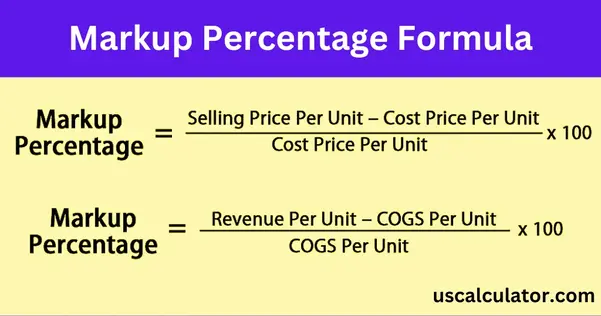
We have given the formula for calculating markup here, and also given an example of calculating markup.
The basic formula for calculating markup is
Markup = Selling Price - Cost Price
or, if expressed as a percentage:
| Markup Percentage = ( |
| ) × 100 |
For example, if a product costs $50 to produce, and a business wants a 20% markup:
Markup = 0.20 × $50 = $10
The selling price would then be
$50 + $10 = $60.
How do I calculate markup?
Establish the Markup Percentage You Want
Calculate Markup Percentage
| Markup Percentage = ( |
| ) × 100 |
For example, if you have a product with a cost price of $50 and you want a 30% markup
| Markup Percentage = ( |
| ) × 100 = 30% |
Calculate Markup Amount:
Markup Amount = Markup Percentage × Cost Price
Using the example
Markup Amount = 0.30 × $50 = $15
Calculate Selling Price
Selling Price = Cost Price+Markup Amount
In the example
Selling Price = $50 + $15 = $65
Using Markup Amount:
Establish the Markup Amount You Want -
Decide on the fixed amount by which you want to mark up the cost.
Calculate Markup Percentage -
| Markup Percentage = ( |
| ) × 100 |
Calculate Selling Price:
Selling Price=Cost Price+Markup Amount
Example:
Cost Price - $50
Desired Markup - $15 (or 30%)
Using either method, you arrive at a selling price of $65.
What Is the Difference Between Markup and Margin?
Markup and profit margin sound pretty similar at first—they both tell you how much extra cash a business makes over what it spent on a product. But honestly, they work differently, so the numbers they spit out aren’t the same.
Here's the deal: markup uses the cost price when you’re doing the math. Profit margin uses the selling price. That might seem like a tiny detail, but it actually matters a lot. Mixing them up can mess up your prices and leave you wondering where your profits disappeared.
So, markup's all about figuring out how much to tack onto what the item cost before you slap a price tag on it.
| Markup Percentage: Markup % = ( |
| ) × 100 |
For example, suppose an item costs $80 and is sold for $100.
Profit = $100 − $80
Profit = $20
Now calculate markup by comparing the $20 profit with the $80 cost:
| Markup = |
| × 100 |
Markup = 25%
Businesses often use markup when they know the cost of a product and want to decide its selling price.
Profit Margin
Profit margin shows what percentage of the selling price remains as profit after covering the cost.
| Profit Margin Percentage = |
| × 100 |
Using the same example, the profit is still $20. But this time, compare it with the selling price of $100:
| Profit Margin = |
| × 100 |
Profit Margin = 20%
Businesses use profit margin to understand how profitable their sales are.
| Point | Markup | Profit Margin |
|---|---|---|
| Based on | Cost price | Selling price |
| Main use | Setting a selling price | Measuring profit from sales |
| In this example | 25% | 20% |
When you calculate markup, you’re looking at how much extra you’re charging compared to your cost. So, if something costs $80 and you add $20, you’re marking it up by 25% ($20 is 25% of $80). But margin looks at profit compared to the final selling price. In this case, you made $20 on a $100 sale, so that's a 20% margin ($20 is 20% of $100). The percentage drops because margin is based on a bigger number—the selling price—instead of just the cost. That’s why profit margin is always lower than markup for the same amount.
How to Decide a Markup Percentage
Picking a markup percentage isn’t just about slapping on a random number—it’s about figuring out how much extra you need to add to your costs so you can actually run your business, not just make a quick profit. That extra amount has to cover everything from rent and salaries to utility bills, software, and shipping. Just going with “25%” or “50%” because it sounds right doesn’t cut it. You need to look at what really fits your business—your costs, your competition, your customers, and how much profit you want.
What Should You Consider?
Start by breaking things down:
Cost of the product or service: This is your starting point—what you paid, or what it takes to make the thing you’re selling.
Operating expenses: Stuff like rent, electricity, internet, software, packaging, and delivery. These are the bills that keep coming in, even if sales slow down.
Labor and overhead: Your employees need to get paid. On top of that, you’ve got overhead—costs like office rent or equipment repairs that keep the place running but aren’t tied to just one product.
Competitor prices: If someone else is selling the same thing for less, you’ll have to think hard about how much more you can charge.
Customer demand: If people are lining up for what you’ve got and can’t find it anywhere else, they’ll pay more. But if they can get something similar from lots of other places, you might need to ease up on your markup.
Perceived value: Sometimes people pay more simply because they think your product is better—maybe it’s quality, maybe it’s the brand, design, or customer service.
Expected sales volume: If you sell in huge numbers, you can get away with a lower markup. When sales are smaller, your markup needs to make up for it.
Profit goals: Decide how much money you actually want to make after covering everything.
Risks and unexpected losses: Things happen—returns, discounts, damaged goods, leftover stock. Markup needs to leave some wiggle room for the bumps in the road.
Take all of this into account before you settle on your markup. There’s no magic number—it’s about what fits your business and helps you stay afloat, stay competitive, and grow.
Calculating the Selling Price
Once the cost and target markup are known, use this formula:
| Selling Price = Cost × (1 + |
| ) |
This formula starts with the cost price and adds the chosen percentage of that cost.
For example, imagine that the cost of a product is $80 and the business chooses a 25% markup.
| Selling Price = 80 × (1 + |
| ) |
First, convert 25% into decimal form:
| = 0.25 |
Then add 1:
1 + 0.25 = 1.25
Finally, multiply the cost by 1.25:
80 × 1.25 = 100
Selling Price = $100
The business makes $20 above the $80 it costs to get the product, but that extra $20 isn’t pure profit. There are still bills to pay—rent, salaries, taxes, delivery, and plenty of other operating costs.
Here’s the thing: there’s no one-size-fits-all markup that works for every business. What's right really depends on your industry, the product you're selling, the competition, what customers expect, and of course, your actual expenses. If you set your markup too low, you might get more customers, but it might not be enough to keep the lights on. Go too high, and you make more on each sale, but you risk scaring customers away with higher prices.
Let’s say two shops each sell an $80 item. One adds a 25% markup, the other goes for 50%. The shop with the higher markup gets more money per sale, but customers might not bite if they feel the price is too steep, leading to fewer sales overall. On the other hand, the shop with the lower markup might pull in more buyers but won’t make as much on each transaction. So, the right choice really comes down to finding that sweet spot between covering your costs and keeping customers happy.
What Markup Really Covers
Markup isn’t just a number you tack onto the cost of something and call it profit. A lot of people think it’s all extra money in the pocket, but that’s not how it works. That extra bit actually goes toward covering a whole bunch of business costs, from rent and employee salaries to boxes and shipping fees. Only what’s left after all those bills are paid is the real profit.
So setting your markup takes some thought. If you set it too low, you might sell a lot, sure, but you’ll still be scrambling just to keep the lights on.
What Goes Into Pricing
Your selling price has to cover more than just what you paid for the product. Here’s what actually goes into that number:
Cost of goods sold (COGS): This is what it costs to buy or make the product.
Packaging and shipping: Think boxes, bags, labels, plus all those delivery and transport charges.
Labor costs: Wages, salaries, benefits—the whole crew needs to get paid.
Rent and utilities: Shop rent, electricity, water, internet, phone bills—none of it’s free.
Marketing and advertising: Stuff like social media ads, posters, websites, promotions, and any campaigns you run.
Payment processing fees: Banks, card machines, online platforms—all take their cut.
Software and admin: You’ve got to pay for accounting software, billing systems, office supplies, and all the admin work.
Taxes and duties: Depending where you’re selling and what you’re selling, you’ll end up paying taxes and duties. The rules can change depending on location and sale type.
Returns, damaged stock, and waste: You’ll deal with products coming back, breaking, expiring, or just not selling.
Desired profit: Once everything else is covered, there should be some money left over. That’s what makes the whole business worthwhile and gives you the chance to grow down the line.
Gross Profit and Net Profit
It is important to understand the difference between gross profit and net profit.
Gross Profit = Selling Price − COGS
Gross profit is the money left after subtracting only the direct cost of the product.
Net Profit = Revenue − All Business Expenses
Net profit is what’s left after a business pays for everything—rent, wages, marketing, interest, taxes, and more. So even if a product has a solid markup and a strong gross profit, high overall expenses can eat away most (or even all) of that profit.
Retail Shop Example
Let’s break it down. Say a shop buys something for $60 and sells it for $100. The gross profit is easy: $100 minus $60, so $40. Gross Profit = $40 But that $40 doesn’t just sit there as final profit. Out of it, the business still has to pay staff, cover the rent, maybe run some ads, handle online payment fees, sort out packaging, replace damaged goods, or take back returns—whatever costs come up. If all those extra costs add up to $35 for that sale, there’s only $5 of net profit left.
A good markup helps, because it gives the business more to play with after those extra expenses. But here’s the point: just because there’s $40 in gross profit doesn’t mean the retailer walks away with $40 in their pocket. High business costs can chip away at that amount, sometimes until there’s very little left. That’s the main reason gross profit doesn’t automatically equal what the business truly earns in the end.
Cost-Plus Pricing
Cost-plus pricing is a straightforward way for businesses to set prices. You start by adding up everything it takes to produce and sell the product or service—things like materials, labor, packaging, shipping, and a fair share of overhead like rent or software. Once you have that total, you tack on a fixed percentage as profit. That’s your selling price.
So, really, it’s just: find your costs, add your markup, and you’re done.
Here’s the quick formula:
Selling Price = Total Relevant Cost × (1 + Markup Rate)
The total relevant cost is just what it sounds like—all the costs you decide to count for that product. Maybe you include direct costs plus a slice of your overall expenses. The markup rate is just a simple decimal. For example, if you want to add 30%, you’d use 0.30 in the formula.
Let’s walk through a quick example.
Say making and selling your product costs you $200 and you want a 30% markup:
Markup Amount = $200 × 0.30 = $60
Selling Price = $200 + $60 = $260
Selling Price = $260
So you charge $260. But keep in mind, that $60 isn’t guaranteed profit. You might have left out some costs—like returns, surprise expenses, taxes, or extra advertising—which can chip away at your profit.
Advantages
Cost-plus pricing keeps things simple:
It’s consistent; you can use the same approach for lots of different products.
It’s easy to work out—just some basic math.
Everyone in the company can see how you landed on the price.
As long as you’re careful with your costs, you’re more likely to cover them and not lose money.
Limitations
But this method isn’t perfect:
It ignores what customers are willing to pay, so you could price too high or too low.
You might not match what competitors charge.
Your price won’t change if demand suddenly goes up or down.
If you miss any important costs, your price could be too low and hurt your bottom line.
And if your costs change a lot and you don’t update your prices, you can get out of step pretty quickly.
So, maybe you price a product at $260 with a 30% markup, but it turns out that competitors only charge $220. Now you’ve got a problem—most customers won’t pay extra just because your math is neat. Or, if your product is unique and people love it, some might actually pay more than $260, and you’re leaving money on the table.
That’s why businesses using cost-plus pricing still need to check what their customers actually want and what their competitors are doing before they lock in a selling price. Keeping an eye on demand and the market helps make sure your prices make sense.
Market-Based and Value-Based Pricing
When setting prices, companies usually mix different strategies instead of sticking to just one.
With market-based pricing, they check out what competitors are charging, what’s happening in the market, and what customers expect. The problem is, if you just copy your competitor’s prices without knowing their costs or margins, you could end up hurting your own business.
Value-based pricing takes a different angle. Here, prices match the value people think they’re getting. That’s why you see higher prices on things like luxury goods, specialized services, or stuff that saves you time—when people believe it’s worth it, they’ll pay more.
In the end, smart pricing means looking at everything: your costs, your profit goals, what’s going on in the market, and how much value customers see in what you offer. You can’t ignore any of these if you want to get pricing right.
| Approach | Primary Focus | Strength | Limitation |
|---|---|---|---|
| Cost-Plus | Covering costs + target markup | Simple and consistent | Ignores demand and competition |
| Market-Based | Competitor and market prices | Competitive positioning | May ignore your own cost structure |
| Value-Based | Customer-perceived value | Captures premium for high value | Harder to quantify and communicate |
Pricing Decisions by Business Type
Product-Based Businesses
How businesses set prices really depends on how they make their money. Product-based companies—think retailers, wholesalers, manufacturers, or online shops—need to look beyond just the price they pay for each item. They also deal with costs like storing inventory, shipping, packaging, dealing with damaged goods or returns, and all those fees from selling platforms.
Take an example: if a product costs $40 and the business wants a 50% markup, they’d price it at $60. Simple math: $40 times 1.5 equals $60.
But here’s the real catch: most businesses calculate markup based just on what they paid for the product. That’s not the whole story. To set a smart price, you’ve got to factor in everything it takes to get that product into the customer’s hands—shipping, packaging, even platform fees. Otherwise, you’re leaving money on the table.
Service-Based Businesses
If you run a service-based business—whether you’re freelancing, consulting, fixing things, or running an agency—you’ve got a lot more to think about than just your hourly wage. Every hour billed isn’t just your time; you’re also paying for things like employee wages, travel, gear, insurance, software, and all the bits that keep the lights on. A lot of your time might not even be billable. When you add everything up, that “cost per hour” ends up much higher than you’d expect.
Let’s put that into numbers:
Say you spend $50 to deliver one hour of service. If you want a 40% markup, here’s what your price looks like:
$50 × (1 + 40/100) = $70 per hour (before taxes)
Pricing doesn’t stop there, though. You’ll want to consider what the market charges, how skilled you are, the value your customers get, and if you actually have the capacity to take on more work.
Subscription Businesses
For subscriptions—think software, memberships, digital tools, or any kind of recurring plan—pricing works differently. Here, it’s not just about the product. You’ve got costs like marketing to get customers in the first place, hosting, support, payment processing, maintenance, and the people who sign up then leave again (that’s churn). The smart move is to look at what each subscriber is worth over the long term. Retention, ongoing costs, and your profit margin matter more than simple one-tim markups.
Take this example:
Let’s say each subscriber costs you $12 a month to serve. You want a 100% markup, so:
$12 × (1 + 100/100) = $24 per month
But honestly, this is just the tip of the iceberg. If you want the full picture (and to actually make money), you’ve also got to factor in what it costs to land each subscriber, how long they stick around, and what kind of profit you’re making over time.
Typical Markup Percentages by Industry
Here’s a table with some example markup ranges just to give you an idea. Keep in mind, these aren’t official industry standards—real numbers can swing pretty wildly. Things like where the business is located, how the brand wants to be seen, company size, what it costs to run things, how sales are made, who the competitors are, and the exact product or service all make a big difference.
| Industry | Example Markup Range (%) | Example Cost | Example Selling Price at the Midpoint | Important Pricing Consideration |
|---|---|---|---|---|
| Grocery and convenience stores | 15–30 | $2.00 | $2.45 | High volume, low margins, perishability |
| Clothing and apparel | 50–100 | $25.00 | $43.75 | Seasonality, fashion risk, returns |
| Electronics | 10–30 | $200.00 | $240.00 | Rapid price declines, competition |
| Furniture and home goods | 40–80 | $300.00 | $480.00 | Shipping, storage, long sales cycles |
| Beauty and cosmetics | 50–100 | $15.00 | $26.25 | Brand positioning and packaging costs |
| Restaurants and food service | 200–300 (food cost) | $4.00 | $14.00 | Labor, waste, and overhead dominate |
| Wholesale distribution | 10–25 | $50.00 | $58.75 | Volume, logistics, and customer relationships |
| Handmade and craft products | 50–150 | $20.00 | $40.00 | Labor intensity and perceived uniqueness |
| Automotive parts | 30–60 | $40.00 | $58.00 | Inventory investment and competition |
| Professional services | 30–100+ | $60.00 (per hour cost) | $99.00 | Expertise, utilization rate, and value delivered |
FAQ
What’s Markup?
Markup is basically how much extra you charge on top of what something costs you. If you buy something for $80 and sell it for $100, the markup’s $20—or 25% of the original cost.
How Do You Figure Out Markup? (FOrmula)
It’s pretty simple: Markup Amount = Selling Price minus Cost.
Markup Percentage = (Markup Amount divided by Cost) times 100.
So if you know what you paid and what you’re charging, just subtract, divide, and multiply.
What’s a good markup percentage?
There isn’t a “one size fits all” number. The right markup really depends on your expenses, how fast products move, what your competition is doing, how much people value your product, and what kind of profit you want. Take a good look at your own costs and your market instead of just grabbing an average number.
How do I convert markup to margin?
Here's the formula: Margin % = Markup % ÷ (100 + Markup %) × 100. So, if your markup is 25%, that works out to a 20% gross profit margin.
Want to go the other way?
Use this: Markup % = Margin % ÷ (100 − Margin %) × 100.
Both percentages just look at the same relationship between your costs and your selling price.
What’s the Difference Between Markup and Profit Margin?
Markup is based on the cost, while profit margin uses the selling price. With an $80 item sold for $100, markup is 25%—but the profit margin is only 20%. Mixing them up messes with your pricing, so make sure you use the right calculation.
What is Cost of Goods Sold (COGS) and Why Does It Matter for Markup?
COGS covers all the direct costs needed to make or buy what you sell. It’s the starting point for figuring out your gross profit and deciding how much to mark up your prices. If you leave out important direct costs, you end up charging too little. While overhead and operating expenses aren’t part of COGS, the money you make over COGS—your gross profit—still has to pay for those, too.
How do I figure out selling price from cost and markup?
It’s simple: Selling Price = Cost × (1 + Markup % ÷ 100).
For example, if something costs $50 and you want a 30% markup, you’d price it at $65 ($50 × 1.30).
How Should Service Businesses Think About Markup?
If you offer services, figure out what it really costs you for every billable hour. That means labor, overhead, any tools or software you use, insurance, travel, and even those hours you can’t bill to anyone. Add your markup on top of that. Of course, what you charge will also depend on market rates and the value you bring to your clients. Starting with a simple cost-plus model works, but always double-check it against what’s happening in your industry.
Does a Higher Markup Always Mean Higher Profit?
Not always. Raising your markup can actually backfire if your customers care a lot about price. Sometimes, it works better to lower your prices and sell more. Whether that leads to more profit really depends on your costs, how much people want what you’re selling, what your competitors are doing, and whether you’re stuck with unsold stock. Don’t just guess—test your pricing and see what actually works.
Is a 20% margin the same as a 25% markup?
Actually, yes. If your cost and selling price line up, a 20% gross profit margin matches a 25% markup. Here’s how it shakes out: Let’s say something costs $100 and you sell it for $125. The markup is $25, which is 25% of the cost ($25 divided by $100, times 100). For margin, you take the same $25 profit, divide it by the selling price ($125), and you get 20%.
What does a 20% markup mean?
A 20% markup means you add 20% of the cost to the price. So, if something costs $100, you tack on $20 and sell it for $120. Keep in mind, though, that a 20% markup doesn’t give you a 20% margin. In this case, your margin winds up just shy of 17% (specifically, 16.67%).
More sources are provided here.
Retail Markup on Common Items
How to Price Food to Sell: A Practical Guide for Restaurant and Food Business Operators