Commission Calculator
Quickly calculate sales commissions with our free Commission Calculator! Just enter your sale amount and commission rate to see exactly what you'll earn.
Share Calculator


Business Calculators | |
Table of Contents
- 1. About Commission and calculation
- 2. Commission Rate Calculation Formula
- 3. All Types of Commission Calculation Examples
- 4. Real Estate Agent Commission Rate Calculation
- 5. Different Commission Structures
- 6. Different Commission Structures
- 7. Factors That Affect Commission Earnings
- 8. Frequently Asked Questions (FAQ)
About Commission and calculation
We will study the commission. We will understand the basic information about commissions very easily. First, let us know what a commission is. The remuneration given to an agent in exchange for his work is called commission or brokerage. Whatever remuneration an agent gets in return for their work is called a commission. There are two types of commissions: The normal commission, which is given on the sale made, that is called the normal commission. The other is the assured commission. The additional commission given to the agent on the recovery of credit sales is called an assured commission or del-creditor commission.
How do I find the commission amount? A question is given here. An agent gets a 15% commission on the sale of goods. If he made sales of $40,000 in the last month, then find his commission. We use this formula to find the commission. The simple formula is commission amount = sales × commission rate / 100. Here, the sales are $40,000, and the commission rate is 15%. Commission amount = 40000 × 15/100, so $6000. Thus, the commission amount will be $6000.
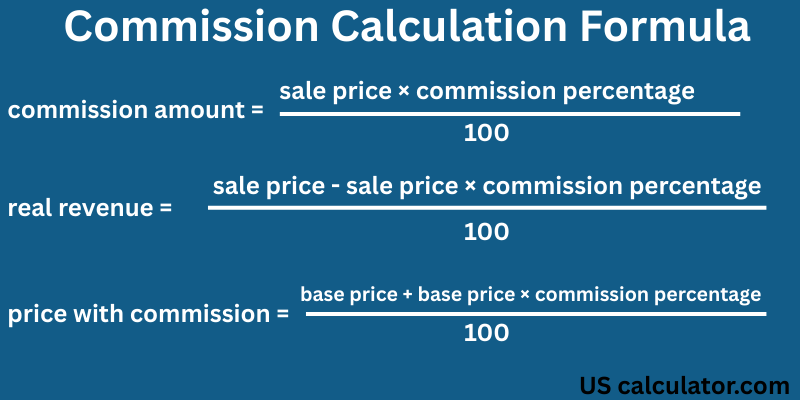
Commission Rate Calculation Formula
Basic Commission Formula
Here's the simplest way to figure out commission: just multiply total sales by the commission rate, then divide by 100.
Commission = Total Sales × Commission Rate ÷ 100
So, if someone sells $10,000 worth of products and the rate is 5%, you do this:
Commission = $10,000 × 5 ÷ 100 = $500
Commission Rate Formula
Sometimes, you know the total commission earned and the total sales, but you want to find the commission rate. Here's how:
Commission Rate (%) = Commission ÷ Total Sales × 100
So, let's say you earned $750 commission from $15,000 in sales:
Commission Rate = $750 ÷ $15,000 × 100 = 5%
Total Earnings With Commission
If a person gets both a base salary and a commission, add them together to find total earnings:
Total Earnings = Base Salary + Commission
For example, with a $3,000 salary and $800 commission:
Total Earnings = $3,000 + $800 = $3,800
Total Sales Formula
To figure out the total sales needed for a certain commission, just use this formula:
Total Sales = Commission ÷ (Commission Rate ÷ 100)
So, if you want to earn $2,000 at a 5% commission rate, it looks like this:
Total Sales = 2,000 ÷ (5 ÷ 100) = $40,000
Tiered Commission Formula
With a progressive tiered system, each sales tier has its own rate. Only the sales within each tier get that rate. Sometimes, after hitting a certain threshold, the whole amount gets a new rate—but here's how it works when each tier is separate:
Let's say the setup looks like this:
5% on the first $10,000
8% on anything above $10,000
If you make $18,000 in sales:
First $10,000 × 5% = $500
Next $8,000 × 8% = $640
Add them up—total commission is $1,140.
Commission After Returns or Discounts
Sometimes, commissions are based only on net sales (after returns or approved discounts). When that's the case, use:
Net Eligible Sales = Gross Sales - Eligible Returns - Eligible Discounts
Then,
Commission = Net Eligible Sales × Commission Rate ÷ 100
Policies can differ, so always check the exact terms of your company's commission plan.
Split Commission Formula
When two or more people share a commission, here's how you figure out what each person gets:
Individual Commission = Total Commission × Individual Share (%) ÷ 100
Let's say the total commission is $6,000 and it's split 60:40 between two agents.
Agent A gets: 6,000 × 60 ÷ 100 = $3,600
Agent B gets: 6,000 × 40 ÷ 100 = $2,400
Gross Profit Commission Formula
If you're paid commission based on gross profit, the calculation works like this:
First, find the gross profit:
Gross Profit = Sales Revenue - Cost of Goods Sold
Then, calculate the commission:
Commission = Gross Profit × Commission Rate ÷ 100
This method is different from a straight sales commission—it only counts the money left over after covering the costs of whatever was sold.
Do you know that? Accurate commission calculations require knowledge of the commission rate formula. We have given the formula for commission calculation below. The formula is simple to use -
Commission Amount = Total Sales × Commission Rate ÷ 100
By multiplying the entire sales or transaction value by the preset commission rate, you may use this formula to get the commission amount.
All Types of Commission Calculation Examples
Basic Sales Commission
Sales = $10,000, Rate = 5%
Commission = 10,000 × 5 ÷ 100 = $500
Calculate a 1% Commission
Sales = $20,000, Rate = 1%
Commission = 20,000 × 1 ÷ 100 = $200
Example 3 — Calculate a 2% Commission
Sales = $15,000, Rate = 2%
Commission = 15,000 × 2 ÷ 100 = $300
Calculate a 3% Commission
Sales = $25,000, Rate = 3%
Commission = 25,000 × 3 ÷ 100 = $750
Calculate a 10% Commission
Project value = $2,000, Rate = 10%
Commission = 2,000 × 10 ÷ 100 = $200
Salary Plus Commission
Base salary = $3,000, Sales = $20,000, Rate = 4%
Commission = 20,000 × 4 ÷ 100 = $800
Total monthly earnings = 3,000 + 800 = $3,800
Find the Commission Rate
Commission = $750, Sales = $15,000
Rate = 750 ÷ 15,000 × 100 = 5%
Find the Required Sales
Desired commission = $2,000, Rate = 5%
Required sales = 2,000 ÷ (5 ÷ 100) = $40,000
Tiered Commission Calculation (Progressive)
First $10,000 at 5%, sales above $10,000 at 8%. Total sales = $18,000
Tier 1: 10,000 × 5 ÷ 100 = $500
Tier 2: 8,000 × 8 ÷ 100 = $640
Total commission = $1,140
Split Commission
Total commission = $6,000, Ratio = 60:40
Agent A: 6,000 × 60 ÷ 100 = $3,600
Agent B: 6,000 × 40 ÷ 100 = $2,400
Commission on Net Sales
Gross sales = $12,000, Returns = $1,000, Discounts = $500, Rate = 5%
Net eligible sales = 12,000 − 1,000 − 500 = $10,500
Commission = 10,500 × 5 ÷ 100 = $525
Gross Profit Commission
Sales revenue = $30,000, Cost of goods sold = $18,000, Rate = 10%
Gross profit = 30,000 − 18,000 = $12,000
Commission = 12,000 × 10 ÷ 100 = $1,200
Real Estate Agent Commission Rate Calculation
Here we will calculate the commission rate based on the formula given above. For example, if a real estate agent closes a deal on a property sold for $300,000 with a 6% commission rate:
Commission Amount = $300,000 × 6/100
The real estate agent's commission in this case would be $18,000.
Commission Practical calculation formula
Let's understand a couple of practical examples of commission calculations -
Example 1: Sales Team Commission Imagine you manage a sales team, and one of your sales representatives, John achieved total sales of $50,000 for the month. If John's commission rate is 8%, you can calculate his commission using the formula:
Commission Amount = $50,000 × 8/100
John's commission for the month would be $4,000.
Example 2: Real Estate Transaction Suppose you are a real estate agent involved in a property sale with a value of $500,000 and a 5% commission rate:
Commission Amount = $500,000 × 5/100
In this case, your commission for the transaction would be $25,000.
Different Commission Structures
| Commission Structure | How It Works | Example | Advantages | Best For |
|---|---|---|---|---|
| Straight Commission | Earnings depend entirely on sales; no base salary | 5% of all sales | High earning potential; strong performance incentive | Experienced salespeople, independent agents |
| Salary Plus Commission | Fixed base pay + variable commission | $3,000 salary + 4% commission | Income stability with upside potential | Most employed sales roles |
| Tiered Commission | Rates change at defined sales thresholds | 5% up to $10k, 8% above | Rewards higher performance | Teams with clear volume goals |
| Progressive Commission | Each rate applies only to sales within its tier | 5% on first $10k, 8% on amount above $10k | Fair and motivational | Sales organizations focused on growth |
| Revenue-Based Commission | Percentage of total eligible sales revenue | 3% of all closed deals | Simple and transparent | High-volume sales environments |
| Gross Profit-Based Commission | Percentage of sales revenue minus cost of goods | 10% of gross profit | Protects company margins | Businesses with varying product costs |
| Residual Commission | Ongoing payments from renewals or subscriptions | 10% of monthly recurring revenue | Builds long-term income | Insurance, SaaS, subscription sales |
| Draw Against Commission | Advance payment recovered from future commissions | $2,000 monthly draw | Provides cash flow support | New salespeople or long sales cycles |
| Split Commission | Shared between multiple people | 60/40 split of total commission | Encourages teamwork | Real estate, team selling, partnerships |
| Bonus Plus Commission | Regular commission plus performance bonuses | Commission + $1,000 quarterly bonus | Extra motivation for targets | Competitive sales teams |
Different Commission Structures
Commission rates vary widely by industry, company policy, product margins, role responsibilities, and local market conditions. The figures below are examples only and should not be treated as universal standards.
| Industry | Common Commission Arrangement | Illustrative Rate or Example | How Commission Is Calculated |
|---|---|---|---|
| Real Estate | Percentage of sale price (often split) | Typically around 5–6% total, then split | Percentage of property sale price |
| Retail Sales | Percentage of sales revenue | Often 1–5% or higher for specialty items | Percentage of eligible sales |
| Insurance | Percentage of premium (higher on new business) | Varies widely by product line | Percentage of premium or first-year premium |
| Automotive Sales | Often based on gross profit | Frequently a share of dealer gross profit | Percentage of gross profit on the vehicle |
| Financial Services | Percentage of assets, fees, or products sold | Varies by product and firm | Percentage of revenue or assets under management |
| Recruiting / Staffing | Percentage of first-year salary or placement fee | Often 15–25% of first-year compensation | Percentage of placement fee or salary |
| Affiliate Marketing | Percentage of sale or fixed CPA | Wide range depending on niche and offer | Percentage of sale or fixed payout per action |
| Freelance Sales / Consulting | Percentage of project or deal value | Commonly negotiated (e.g., 5–15%) | Percentage of project or closed deal value |
Factors That Affect Commission Earnings
Commission’s that extra cash you make when you hit your sales targets, but it’s not always a simple formula. How much you actually take home depends on a handful of important things.
First, the more you sell, the bigger your commission check—pretty straightforward. But the percentage you earn (your commission rate) makes a huge difference. Scoring a 5% cut on a sale means more money than a 2% cut, even if you’re selling the same stuff.
Some companies dangle bonus commissions or incentives if you smash your targets for the month or quarter. Others tie your commission to the profit, not just the price tag, so selling something with a high margin pays off way more than pushing cheaper or less profitable products.
Now, watch out for returns and cancellations. If a customer sends something back or cancels, don’t be surprised if you see your commission shrink a bit.
Commission structures can get even more interesting. Sometimes, once you hit a certain sales number, your commission rate jumps up. Or, your pay can hinge on how you and your whole team perform, not just your solo numbers.
Finally, companies have their own rules for paying out. Some hand over commission right away. Others wait until customers actually pay, or they’ll hold a portion back for a while, just in case.
Understanding these ins and outs helps you set clear goals each month. Focus on hitting higher tiers, watch out for returns, and go after the most profitable deals—you’ll see your commission stack up faster.
Frequently Asked Questions (FAQ)
What is a typical commission?
There is no single “normal” commission rate because it depends on the industry, job role, and company policy. Some companies calculate commission from total sales, while others calculate it from the profit made on each sale.
How is commission calculated?
Use this basic formula:
Commission=Total Sales × Commission Rate ÷ 100
For example, if your sales are $10,000 and your commission rate is 5%:
10,000 × 5 ÷ 100 = 500
So, your commission would be $500.
How Do I Calculate a 1% Commission?
Commission = Sales × 1 ÷ 100
On $10,000 sales: 10,000 × 1 ÷ 100 = $100.
How Do I Calculate a 2% Commission?
Commission = Sales × 2 ÷ 100
On $10,000 sales: 10,000 × 2 ÷ 100 = $200.
How Do I Calculate a 3% Commission?
Commission = Sales × 3 ÷ 100
On $10,000 sales: 10,000 × 3 ÷ 100 = $300.
Is commission calculated before tax?
Usually, the company first calculates your commission from the eligible sales or profit. After that, tax and other required deductions may be taken from your payment, depending on local rules.
Commission vs. bonus
Commission is money earned directly from making sales or completing deals. A bonus is an extra reward that may be given for reaching a bigger goal, such as meeting a yearly target or helping the company perform well.
Can you earn salary and commission?
Yes. Many sales jobs offer both a fixed salary and commission.
For example:
Total Income = Salary + Commission
If your salary is $3,000 and you earn 4% commission on $20,000 in sales:
20,000 × 4 ÷ 100 = 800
3,000 + 800 = 3,800
Your total income would be $3,800.
What are tiered commissions?
A tiered commission system uses different commission rates at different sales levels. For example, a company may pay one rate for the first part of your sales and a higher rate after you cross a sales target. Always read the company's commission rules carefully, because some plans apply the new rate only to additional sales, while others apply it to all eligible sales.
How to calculate commission in Excel
In Excel, you can use:
=A2*B2/100
Here, A2 is the sales amount and B2 is the commission percentage written as a whole number, such as 5 for 5%.