Compound Interest Calculator
Want to see the magic of compounding? Our free compound interest calculator shows how small, regular investments can snowball into big returns over time. Just enter your principal, interest rate, and time to visualize your wealth growth. Ideal for investors, students, and retirement planners.
Share Calculator


Table of Contents
- 1. Understanding Compound Interest:
- 2. Compound Interest Calculation Formula
- 3. Compound Interest Examples
- 4. Yearly vs Monthly vs Daily Compounding
- 5. Use of Compound Interest Calculators in India:
- 6. Common Misjudgments Made by Individuals When Using Compound Interest Calculators
- 7. How to Utilize Compounding for Your Benefit
- 8. Frequently Asked Questions
Understanding Compound Interest:
Here, what kind of topic is compound interest, what kind of topic is it, and what things are said here? We know here, so what is the difference between simple and compound interest? For example, if we are giving you $100 and giving it at the rate of 10%, then as per simple interest, The interest calculated in the first year will also be $100, the interest calculated in the second year will also be on $100, the interest calculated in the third year will also be on $100, and the interest that will come every year will be fixed and will be $10. But when we talk of compound interest, it means that in the first year, the interest we will get here is 10% of $100, that is, $10. Now, the interest in the first year will come to you, so what you will do here is add $10 to $100, and then it will become $110. Now, your principal is no longer $100; it has become $110. The interest that will be calculated will be on top of $110. Then we will find out it is 10%, which is $11, and by doing this, the value will keep on adding; that is, compound interest means that you get interest on the principal as well as the interest on the interest. So here, this value is much bigger than simple interest. We will calculate the entire compound interest in three ways, and these three methods are quite popular. First, if we talk about it here, the first method is the ratio method, and the second is the successive method. And the third is the tree method.
Compound Interest Calculation Formula
Compound interest is the "interest on interest" that makes your money grow faster over time. Unlike simple interest, it reinvests earnings, creating exponential growth. Here's how to calculate it with real-world examples.
Compound Interest Formula
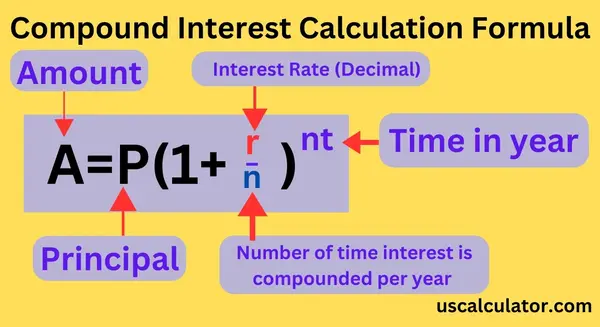
The standard compound interest formula is:
| A = P × ( 1 + |
| ) n × t |
Where:
A = Future value of investment, Final amount (including interest)
P = Principal amount (initial investment)
r = Annual interest rate (in decimal)
n = Number of times interest is compounded per year
t = Time in years
Total Interest Earned:
Interest = A - P
Compound Interest Examples
Example 1: Annual Compounding (n=1)
let's look at an actual example. Suppose you invest $100,000 at an annual interest rate of 8%, with interest compounded once per year. for 5 years. When we enter these figures into the compound interest formula, we get the following -
Principal (P): $100,000
Annual Rate (r): 8% (0.08)
Time (t): 5 years
Compounding (n): Once per year
Calculation:
| A = 100,000 × ( 1 + |
| ) 1 × 5 = 100,000 × (1.08) 5 = $146,933 |
Interest Earned: $146,933 - $100,000 = $46,933
Example 2: Monthly Compounding (n=12)
let's look at an actual example. Suppose you invest $100,000 at an annual interest rate of 8%, with interest compounded once per month. for 5 years. When we enter these figures into the compound interest formula, we get the following -
Principal (P): $100,000
Annual Rate (r): 8% (0.08)
Time (t): 5 years
Compounding (n): 12 times/year
Calculation:
| A = 100,000 × ( 1 + |
| ) 12 × 5 = 100,000 × (1.006667) 60 = $149,175 |
Interest Earned: ₹1,49,175 - ₹1,00,000 = ₹49,175
let's look at an actual example. Suppose you invest $5,000 at an annual interest rate of 6%, with interest compounded once per Quarterly. for 2 years. When we enter these figures into the compound interest formula, we get the following:
Example 3: Compounded Quarterly
Principal (P) = $5,000
Interest Rate (r) = 6% = 0.06
Time (t) = 2 years
Compounded quarterly (n = 4)
| A = 5,000 × ( 1 + |
| ) 4 × 2 = 5,000 × (1.015) 8 = $5,000 × 1.1268 = $5,634 |
Compound Interest Earned = $5,634 - $5,000 = $634
Yearly vs Monthly vs Daily Compounding
Compound interest grows your money not only on the amount you originally invest, but also on the interest already earned. The main difference between compounding options is how often that interest is added back to the principal.
Yearly compound interest
ith yearly compounding, interest is calculated and added once a year. This is common in many traditional fixed deposits and some government-backed savings schemes.
Because interest is added only once annually, yearly compounding is the slowest of the three common frequencies. Your money still grows steadily, but it has fewer chances to earn interest on earlier interest within the same year. The standard formula is
| A = P ( 1 + |
| ) t |
A = P (1 + r/1)^(1 × t)
or simply
A = P (1 + r)^t
Monthly compound interest
With monthly compounding, interest is calculated and added each month. This is commonplace in savings accounts, fixed deposit accounts, and various investment products, the payments of which may be credited at a higher frequency than every 12 months.
In general, monthly compounding leads to higher amounts of money than annual compounding, as in this case, interest for each month is generating more interest. The formula is given as follows:
| A = P ( 1 + |
| ) 12t |
A = P (1 + r/12)^(12 × t)
Daily compound interest
With daily compounding, interest is calculated every day. Some high-yield savings products and certain credit accounts use this method.
Daily compounding usually produces the highest return of the three, but the difference between daily and monthly compounding is often small over typical investment periods. The formula is commonly expressed as
| A = P ( 1 + |
| ) 365 t |
A = P (1 + r/365)^(365 × t)
though some systems use 360 instead of 365.
The greater the frequency of compounding.
When compounding is applied more frequently, the interest starts earning more interest as a result. Hence, daily compounding will upgrade monthly compounding and monthly, yearly compounding.
In simple terms, this improvement can be seen, but it is not always considerable. For instance, the switch from annual to monthly interest is more important than going from monthly to daily, especially at low rates of interest and short timeframes.
Example
Consider an approximate illustration:
₹5,00,000 invested at 8% for 15 years.
Yearly compounding gives the lowest final amount among these three options.
Monthly compounding gives a noticeably higher amount than yearly.
Daily compounding gives a small additional increase over monthly.
For a comparable rate example, published comparisons show that the jump from monthly to daily compounding can be quite small, while the shift from annual to monthly is usually more noticeable.
Use of Compound Interest Calculators in India:
Use of Compound Interest Calculators in India: Essential Points to Note for Savers in India
Most investors in India are likely to include the following:
Bank fixed deposits and recurring deposits
Public Provident Fund (PPF) – provides annual compounding of interest
Equity and debt mutual funds – returns are variable but considered growth
National Savings Certificates and other small savings schemes
When using a compound interest calculator India edition, you must check the following two points. Firstly, whether the tool allows for the input of periodic contributions similar to SIP. Secondly, whether it gives an effective yearly yield after the compounding frequency.
Keep in mind tax implications relevant to your investments. Tax slabs are deemed applicable to fixed deposit earnings, while PPF returns are non-taxable as per the current law. With equity mutual funds, there are varying rates according to the duration of holding the investment.
Common Misjudgments Made by Individuals When Using Compound Interest Calculators
Crediting compound interest calculator with over-optimistic rates of return
Not taking into account inflation ($1,000 today will not be able to purchase what can be purchased for $1,000 20 years from now)
Neglecting the effect of inflation
Forgetting to add taxes to the calculation
Believing that the return remains unchanged in the future
Ceasing contributions too soon and thereby making the compounding process impossible
A calculator should be viewed as a guiding tool rather than an infallible solution. Use the tool to explore various alternatives, and make sure to stick to their strategy.
How to Utilize Compounding for Your Benefit
Begin as soon as possible. Time is the greatest factor.
Make regular contributions. Even small sums put to work regularly can give great results.
Do not withdraw the returns you earn from your investments; rather, reinvest them.
Select the best frequency of compounding that is practical given the risks you are willing to take.
Review the plan every year or so and change contributions according to your rising income.
These rules are far more important than using the utmost in calculating devices.
Frequently Asked Questions
1. What is the difference between a yearly and monthly compound interest calculator?
A yearly calculator adds interest once a year. A monthly calculator adds it twelve times a year. Monthly compounding therefore produces a higher final amount at the same nominal rate because interest starts earning interest sooner.
2. Is daily compounding more advantageous?
In theory, yes. In reality, however, the differences between daily and monthly compounding for normal rates of return and periods of investment are usually quite insignificant. The benefits of daily compounding becomes apparent only when the rate is very attractive and the investment product meets the investor's requirements.
3. Can I apply a compound interest calculator for SMS of mutual funds?
Yes. The long-term average rate of return may be taken as a rate; select a compounding option available which is closest to monthly; and enter the monthly SMS amount as the regular contribution. Do not forget that mutual fund returns are variable, and the calculator provides only an estimate.
4. Does the compound interest calculator India version account for tax?
Most free online tools do not automatically deduct tax. You need to adjust the rate or final amount yourself based on the tax rules that apply to the specific product.
5. How accurate are online compound interest calculators?
They are accurate for the inputs you give them. Accuracy of the plan depends on how realistic your rate, time horizon and contribution assumptions are.