Break-Even Calculator
Launching a business or product? Our free Break-Even Calculator reveals exactly when you'll start making money. Just input Fixed Costs, Cost Per Unit, and Revenue Per Unit, and get instant clarity on your profit timeline. Perfect for startups, entrepreneurs, and savvy planners.
Share Calculator


Business Calculators | |
Table of Contents
- 1. About Break-Even Calculation
- 2. What is Break-Even Analysis?
- 3. Break-Even Calculation Formula
- 4. Key Definitions (Key Inputs You Need)
- 5. Break-Even Calculation Example
- 6. Calculation Examples for Three Businesses
- 7. Why every business owner needs to know their break-even point
- 8. How do you figure out your break-even point?
- 9. Target Profit and Margin of Safety Explained
- 10. Break-Even for Different Businesses: Product, Service, and Retail
- 11. How to Use Break-Even in Real-Life Decisions
- 12. Common Break-Even Mistakes
- 13. Break-Even Calculator FAQs
- 14. References for Business Calculation Units:
About Break-Even Calculation
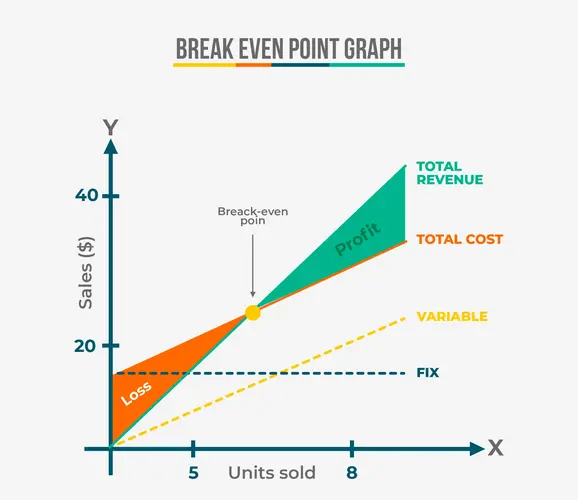
On this page, we understand what the break-even point is. How do we calculate it? What is its formula? We know the concept with examples. So the first thing that comes to mind is: What is the break-even point? The break-even point is also called the break-even level. The break-even point is above which our sales and total costs are equal. It means neither we make a profit nor do we incur a loss. It means we have recovered as much as we have spent. But we are neither making a profit nor making a loss. Those are the points. Now the question arises: does it mean sales are similar to total costs?
The total cost is our variable cost plus our fixed cost. Now, what is a fixed cost? Like any rent, machinery, or whatever expenditure you have incurred on it, your fixed cost. And after that, what is the variable cost? You brought some raw materials, some labor charges, and electricity bills—all these are variable costs. So if we add the variable and the fixed cost, we get our total cost. And when our sales recover the total cost, we call that point a break-even point. Now we come to the question: how do we calculate the break-even point? The formula for the break-even point is fixed cost divided by the CM ratio and multiplied by 100.
Now, what is the CM ratio? For our CM ratio, we need to find CM. Now, how will we find CM? We will subtract the variable cost from the sales. The answer that comes will be our CM. The answer for CM will be divided by the total sales and multiplied by 100. So, the ratio that comes will be called the CM ratio.
Now, how do we find the break-even point? We divide the total fixed cost by the CM ratio and multiply it by 100. So, the answer that comes is our break-even point. That means we come to know from that answer that if we make this many sales, then whatever our back cost, our expenditure, and of course that expenditure is fixed or variable, both the expenses will be recovered. This tells us this: I hope you know its concept.
What is Break-Even Analysis?
A basic financial calculation called break-even analysis establishes the point at which total revenue and total costs are equal. A business is currently neither losing money nor turning a profit. It's an essential tool for:
Establishing a business: Assessing a business idea's viability.
Product pricing: Recognizing the impact of price adjustments on profitability.
Analyzing the effects of both variable and fixed costs is known as cost control.
Establishing sales goals: Being aware of the bare minimum of sales required to prevent losses.
Break-Even Calculation Formula
The Break-Even Point is calculated using the following formula:
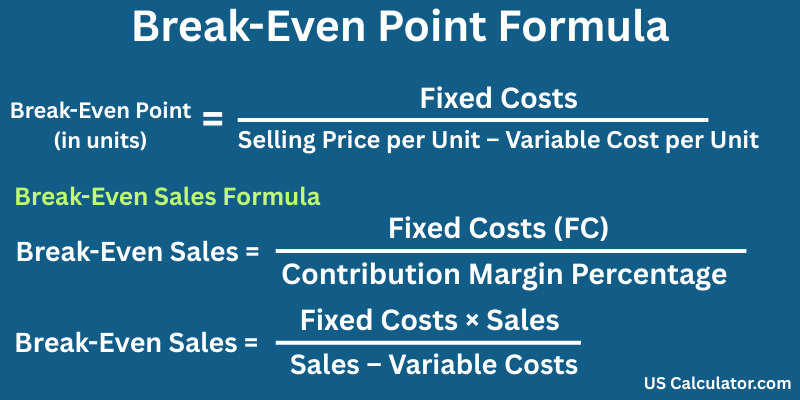
| Break-Even Point (Units) = |
|
| Break even Point (Price) = |
|
Break-Even Sales Formula
| Break-Even Sales = |
|
| Break-Even Sales = |
|
Or for revenue:
Break-Even Revenue = Break-Even Units × Selling Price per Unit
Break-Even Sales Revenue = Fixed Costs ÷ Contribution Margin Ratio
When using the contribution margin ratio in the revenue formula, express it as a decimal. For example, a 40% ratio is entered as 0.40.
Example Short numerical illustration
Fixed costs = $6,000
Selling price = $50
Variable cost = $30
Contribution margin per unit = $50 − $30 = $20
Break-even units = $6,000 ÷ $20 = 300 units
Contribution margin ratio = ($20 ÷ $50) × 100 = 40% (or 0.40)
Break-even sales revenue = $6,000 ÷ 0.40 = $15,000
(Alternatively: 300 units × $50 = $15,000.)
These formulas give the sales level at which contribution margin exactly covers fixed costs. Everything beyond that point contributes to profit (under the model’s assumptions).
Key Definitions (Key Inputs You Need)
Getting accurate results starts with clean, consistent data—all from the same period, whether that's a month, a quarter, or a year.
Fixed costs don’t budge much, at least not within day-to-day operations. Stuff like rent, insurance, fixed software subscriptions, equipment leases, and salaries—it’s all pretty steady. Sure, you might see these costs jump if you expand, like moving to a bigger warehouse. But generally, selling a few more units won’t affect them.
On the flip side, variable costs increase as you sell more. Think raw materials, packaging, sales commissions, payment processing fees, and any production or fulfillment that goes by unit. The more you sell or deliver, the higher these costs go—they stick closely to sales volume.
Selling price matters a lot. The price you set for each unit shapes your margin directly. Raise the price, and your break-even point drops; lower it, and you’ll need to sell more just to break even. Make sure you use the net amount you actually keep after deducting variable costs.
And don’t mix periods. If you use yearly fixed costs but monthly sales projections, or leave out variable costs like packaging and fees, you’re asking for trouble. Skipping those details means you’re overestimating the margin and underestimating how much you need to sell to break even.
Break-Even Calculation Example
Example 1. if your fixed costs amount to $10,000, the selling price per unit is $50, and the variable cost per unit is $30, the Break-Even Point in units would be:
| Break-Even Units = |
| = 500 |
Break-Even Revenue = 500 × $50 = $25,000
Interpretation: You need to sell 500 units (or $25,000 worth) to cover costs.
Example 2. if your fixed costs amount to $ 10,000, the selling price per unit is $ 20, and the variable cost per unit is $ 10, the Break-Even Point in units would be:
| Break-Even Units = |
| = 1000 |
Break-Even Revenue = 100 × $20 = $2,000
Interpretation: You need to sell 1000 units (or $2,000 worth) to cover costs.
Moving on to more intricate estimations is simple. We utilize our useful break-even calculator to figure out the number of units, revenue, margin, and markup using the calculations provided.
Calculation Examples for Three Businesses
Example 1 — Product Business
A small business sells reusable water bottles.
Monthly fixed costs: $3,000
Selling price per bottle: $25
Variable cost per bottle: $10
Contribution margin = $25 − $10 = $15
Break-even units = $3,000 ÷ $15 = 200 bottles
Break-even revenue = 200 × $25 = $5,000
Interpretation: The business needs to sell 200 bottles each month to cover the stated fixed and variable costs. Sales above 200 bottles generate contribution toward profit under these assumptions.
Example 2 — Service Business
A freelance design or consulting business.
Monthly fixed costs: $2,000
Revenue per billable hour: $80
Variable cost per billable hour: $20
Contribution margin per hour = $80 − $20 = $60
Break-even billable hours = $2,000 ÷ $60 ≈ 33.33 → round up to 34 hours if partial hours cannot be billed.
Interpretation: Approximately 34 billable hours per month are required to cover the stated costs. The example assumes the listed costs adequately reflect expenses; the owner should separately consider compensation for their own labor when judging economic profitability.
Example 3 — Retail Business with GST
Hypothetical GST-registered retail business in India. Assumed GST rate: 18%. All figures below are stated clearly as net of GST or inclusive as noted; the example is illustrative only. Actual tax treatment depends on the business’s circumstances and applicable rules.
Monthly fixed costs (net of recoverable GST where applicable): ₹90,000
Customer pays ₹1,180 inclusive of 18% GST → net selling price = ₹1,000
Variable cost per unit (net of eligible input tax credit): ₹600
Contribution margin = ₹1,000 − ₹600 = ₹400
Break-even units = ₹90,000 ÷ ₹400 = 225 units
Break-even net revenue = 225 × ₹1,000 = ₹225,000
Interpretation: The business needs to sell 225 units (generating ₹225,000 net of GST) to cover the stated costs under these assumptions. GST collected is not treated as revenue, and eligible input credits have already been reflected in the net variable cost.
Why every business owner needs to know their break-even point
Every business owner needs to know their break-even point. Basically, it’s the answer to that nagging question: “How much do I have to sell just to cover my costs?” It’s the spot where your income matches your expenses—no profit, no loss, just breaking even.
Understanding this number opens up a lot of doors:
You get a clear minimum sales target. Instead of guessing, you know exactly how many products you need to move or how much revenue you need just to stay afloat.
You can set budgets and goals that actually make sense, not just ones based on hope or gut feelings.
Break-even analysis lets you check if your pricing is working. Are you charging enough to cover costs and make some profit? Now you'll know.
It helps you plan—inventory, production, staffing. If you know how much you need to sell, it's way easier to figure out how much to produce or how many people to hire.
If expenses shift—like rent goes up, you hire more staff, or upgrade software—break-even analysis tells you how much extra you need to sell to cover it.
Thinking about launching a new product or service? This tool helps you see if it can pay for itself and actually turn a profit.
And honestly, when you're starting out or expanding, break-even gives you some control over cash flow and helps reduce those unknowns.
But hitting break-even doesn’t mean you’re in the clear financially. These calculations don’t include everything—like loan payments, day-to-day spending, unexpected costs, or when the cash actually shows up. It’s possible to break even on paper and still be strapped for cash if customers take their time paying.
So, use break-even analysis as a solid planning tool. It’ll help you make smarter moves, but don’t forget to keep an eye on your cash flow, profits, debts, and the usual curveballs that come with running a business.
How do you figure out your break-even point?
How do you figure out your break-even point? Here’s how it works:
Start with your total fixed costs. These costs don’t change, no matter how many products you sell—things like rent, salaries, insurance, or software.
Next, know your selling price for one product. That’s the price you charge customers for a single item.
Now, figure out your variable cost per unit. These costs go up as you sell more, like what you spend on materials, packaging, or shipping for each item.
Subtract your variable cost per unit from your selling price to get your contribution margin per unit. In other words:
Contribution margin = Selling price – Variable cost
That number shows how much each sale pays towards your fixed costs.
To find your break-even point in units, divide your fixed costs by the contribution margin:
Break-even units = Fixed costs / Contribution margin per unit
| Break-even units = |
|
You can’t really sell a fraction of a unit, so always round your answer up to the next whole number. If your math gives you 300.2 units, you need to sell 301.
Here’s a simple example:
Let’s say your business has:
Fixed costs: $6,000 each month
Selling price: $50 per unit
Variable cost: $30 per unit
Your contribution margin is $50 – $30 = $20. Every time you make a sale, $20 helps pay down your fixed costs.
Now, plug it in: calculate the break-even point:
$6,000 / $20 = 300 units
So, you need to sell 300 units in a month to break even—that’s the point where your sales cover both fixed and variable costs.
If you want to know how much money that is, just multiply:
300 units x $50 = $15,000
You need $15,000 in sales per month just to break even. Sell more than 300 units, and you start turning a profit—each extra sale adds $20 to your bottom line.
| Item | Amount |
|---|---|
| Fixed costs | $6,000 |
| Selling price per unit | $50 |
| Variable cost per unit | $30 |
| Contribution margin per unit | $20 |
| Break-even units | 300 |
| Break-even revenue | $15,000 |
Target Profit and Margin of Safety Explained
Break-even analysis just tells you how much you have to sell to cover the bills—but let’s be real, nobody starts a business just to break even. You want to actually make money. That’s where target profit and margin of safety come in.
Break-Even with a Target Profit
Let’s talk about how to figure out what you need to sell to hit a profit goal. Say you want to earn a certain amount this month. Add that profit target to your fixed costs, then divide the total by how much profit you make from each sale (your “contribution margin per unit”).
Here’s the formula:
| Required units = |
|
Let’s plug in some numbers:
Fixed costs: $6,000
Target profit: $4,000
Contribution margin per unit: $20
| × 500 units |
That means you need to sell 500 units to pay all your bills and pocket $4,000 on top. The break-even point was 300 units before, so to hit your profit goal, you need to sell 200 more units. Every unit sold brings in $20 toward covering costs and then toward your profit goal.
What Is Margin of Safety?
Now, what about margin of safety? Think of it as your comfort zone. It’s the gap between your actual (or expected) sales and the sales you need just to break even. It shows how much your sales can drop before you start losing money.
Here’s the simple formula:
Margin of safety = Actual sales - Break-even sales
Or, as a percentage:
| Margin of safety percentage = |
| × 100 |
Let’s run a quick example. Suppose:
Actual sales: $25,000
Break-even sales: $15,000
Margin of safety is $25,000 minus $15,000, so $10,000. That’s how much your sales can fall before you hit break-even. As a percentage, $10,000 divided by $25,000 is 0.4, or 40%.
| ) × 100 = 40% |
A $10,000 (or 40%) margin of safety is pretty solid. It means your business can handle a decent drop in sales before you’re in trouble. On the flip side, a low margin of safety means you’re just hovering above break-even, and a small dip could push you into the red.
Break-Even for Different Businesses: Product, Service, and Retail
Break-even analysis fits just about any business, but the details change depending on what you’re selling. Whether you run a product-based company, offer services, or manage a retail shop, your costs and how you track sales will look pretty different.
Product-Based Businesses
Think manufacturers, folks selling handmade items, or companies pushing packaged goods. These businesses spend most of their money on:
Raw materials
Packaging
Shipping
Making each unit
What really matters here is the contribution margin per unit—the cash you pocket from each product after covering the costs directly tied to making and selling it.
Contribution margin = Selling price – Variable cost per unit
After you figure that out, it’s just a quick step to see how many units you need to sell to clear your fixed costs, like rent, salaries, or equipment.
So, if each unit leaves you with $20 and your fixed monthly costs are $6,000, you’d need to sell 300 units to break even.
Service Businesses
This group covers freelancers, consultants, agencies, repair shops, and just about anyone else selling their know-how or skills. Instead of counting products, service businesses usually measure sales by:
Billable hours
Projects
Clients
Service packages
A consultant, for example, might figure out how many hours they need to work or the number of clients to cover their monthly bills.
One thing you can’t overlook: Don’t pretend the owner’s time is free. Even if you’re not paying yourself a salary at first, your time is still a real cost. Ignore it, and you might think your business is profitable—until you realize paying someone else to do the work would wipe out your margin.
Say you freelance 40 hours a week but don’t pay yourself. On paper, the business might look great. But bring someone else in and pay them a proper wage, and suddenly things change. Always count your own time like you’d count anyone else’s.
Retail Businesses
Retailers buy products from wholesalers or suppliers, then resell them. They’ve got a handful of costs to cover, like:
Wholesale product costs
Rent
Staff wages
Payment-processing fees
Inventory and storage
Retail shops usually sell a bunch of different items, and each one can have its own price and profit margin. Treating all products the same doesn’t work.
A smarter move? Use a weighted-average contribution margin. This averages the margins of everything you sell, weighted by how much of each item moves off the shelves.
If most sales come from low-margin products, your overall average margin drops. Understanding this helps you figure out how much you really need to sell to stay in the black.
Bottom line? No matter what you sell, break-even means your sales have to cover your costs. Product businesses focus on units, service businesses look at hours, projects, or clients, and retailers need to keep an eye on their mix of products.
| Business Type | Typical Variable Costs | Useful Unit of Measurement | Important Consideration |
|---|---|---|---|
| Product | Materials, packaging, shipping | Physical unit | Capacity limits and production efficiency |
| Service | Subcontractor fees, software per client | Billable hour / project / package | Owner labor valuation |
| Retail | Cost of goods, payment fees | Unit sold or revenue | Sales mix and inventory holding costs |
How to Use Break-Even in Real-Life Decisions
Break-even analysis isn’t just about crunching numbers—it’s something business owners can actually use when making decisions about pricing, costs, hiring, whether to run a discount, or even sales goals.
Think of it like this. It gives you clear answers to real questions:
Is the price I'm charging enough to cover my costs?
If I offer a discount or run a promo, what does that do to my bottom line?
How many more sales do I need if I want to bring on a new staff member?
What happens if my rent goes up?
Which supplier or way of making the product actually gives me more profit per item?
If sales go up and down with the seasons, do I need to adjust my targets?
Will this new product idea really turn a profit, once I count every realistic cost?
And finally: How much do I need to sell each month (or year) just to stay afloat, with a bit of safety?
Let's break it down with a couple real-life examples.
Example 1: What Happens if You Raise Your Price
Let's say every month your fixed costs—like rent and salary—are $6,000. You sell your product for $50 each, and it costs you $30 to make each one. That leaves you with $20 "left over" from each sale to cover those fixed costs.
So, your break-even point is $6,000 divided by $20, which means you need to sell 300 units every month to pay the bills.
Now let’s imagine you bump up the price to $55 per unit, but your variable cost stays at $30. Your margin goes up to $25 per unit. So now:
$6,000 divided by $25 means you only need to sell 240 units to break even.
Less stress! But, of course, there’s a catch—you’ve gotta think about whether your customers will still want to buy at that higher price, or if you’ll lose sales.
Example 2: When Your Fixed Costs Go Up
Back to the starting numbers: $6,000 in fixed costs, $50 price, $30 variable cost, $20 margin.
Now, say your landlord hikes the rent and your fixed costs go up by $1,000. Your new fixed cost is $7,000.
Now, you need to sell $7,000 divided by $20—that’s 350 units. Suddenly, you need 50 more sales every month just to break even.
So, a rent hike means you've gotta hustle harder or find a way to bring in more cash.
Key Points to Remember
Break-even analysis isn’t a crystal ball—it’s a planning tool. It helps you spot what needs to happen just to avoid losing money. But it’s not a guarantee you’ll turn a profit. Everything depends on your assumptions—how accurate they are, and if customers actually show up and buy.
So, even if your math says, “Sell 300 units, and you’re in the clear,” real life might throw in a curveball. Maybe demand changes or costs jump up. That’s why it’s smart to keep an eye on your prices, costs, sales numbers, and what’s happening in your market—review them often, and don’t set them on autopilot.
Common Break-Even Mistakes
Break-even analysis can be a powerful tool, but it’s easier than you think to trip up and end up with bad numbers. Here's where people often go wrong—and what you can do about it.
Mixing up fixed and variable costs happens a lot. Think of fixed costs like rent—they don't budget. Variable costs, like materials, rise and fall as you sell more or less. If you swap these around, your break-even number won't make sense.
Including GST in your revenue throws things off. GST isn't your money, so take it out before you work out your revenue.
Skipping small fees and costs—payment fees, packaging, delivery, commissions—can really add up. If the cost goes up when you sell another unit, count it in.
Owners sometimes forget to factor in their own pay. Even if you aren’t drawing a salary, your time isn’t free. Build in something for owner compensation to know if your business is actually worth it.
Mixing up timeframes can scramble your numbers. Don't match up monthly costs with annual sales. Keep everything in the same period—monthly with monthly, yearly with yearly.
Assuming all your products earn you the same margin? That rarely holds up. Different products have different contribution margins. Figure out the average based on how much of each you expect to sell.
Guessing at your prices or sales volume leads to overoptimism. Use real data—past sales, market research, and supplier quotes—so your projections aren’t just wishful thinking.
Don't forget about discounts, returns, damaged goods, or waste. These eat into profits, so adjust your prices or costs to factor them in.
Sometimes your calculation says you need to sell 1,000 units, but you can only make or deliver 500. Always check what’s actually possible for your business.
Reaching break-even doesn't mean the cash is rolling in. You might break even on paper but still run out of money if customers pay late and bills are due now.
Costs never stay the same for long. When prices change, recalculate. Old break-even numbers don't help when the situation shifts.
If your contribution margin is zero or negative, selling more is a losing game. In that situation, either raise your price, cut costs, or rethink the product entirely.
In the end, the key is simple: use real numbers, count every cost that matters, and keep your figures in sync. Break-even analysis only works when it’s based on solid, accurate information.
Break-Even Calculator FAQs
What’s a Break-Even Point?
It’s the moment your sales finally match your costs, so you’re neither making nor losing money—just breaking even. You need to get past this point to start seeing any profit.
How Do You Calculate the Break-Even Point?
Start by figuring out your contribution margin per unit—that’s the selling price minus the variable cost for each unit. Divide your fixed costs by this margin to get the number of units you need to sell to break even. If you want the dollar amount, just multiply that number by your selling price.
Why Does GST Affect My Break-Even Calculation?
GST you collect isn’t really income for your business. Input tax credits you qualify for can cut down your costs. If your customers pay GST, you need to separate the GST from the sale price. GST you can’t recover counts as a cost. The details depend on your registration and local rules.
How Do I Find the Sales Needed for a Target Profit?
Just add your target profit to your fixed costs, then divide by your contribution margin per unit. That tells you how many units you need to hit your goal.
What’s Contribution Margin?
It’s what’s left from each sale after covering variable costs. First, it pays down your fixed costs. After that’s done, whatever’s left is profit.
What’s the Difference Between Fixed and Variable Costs?
Fixed costs, like rent and insurance, stay pretty steady no matter how much you sell. Variable costs—things like materials and commissions—go up as your sales increase
Should I Calculate Break-Even in Units or Revenue?
Units work best if you’re selling just one product or have a clear unit for your business. If you sell lots of products or don’t track units easily, use revenue. Multi-product companies usually need a weighted average contribution margin and a realistic sales mix.
What’s Margin of Safety?
It’s the cushion between your actual (or planned) sales and your break-even sales. You can also express it as a percentage: (margin of safety ÷ actual sales) × 100. The bigger the buffer, the safer you are if sales drop.
How Can I Lower My Break-Even Point?
Cut your fixed costs, negotiate your variable costs down, run things more efficiently, or raise your prices carefully (keep an eye on demand). Anything that bumps up your contribution margin or drops fixed costs helps.
Does Break-Even Analysis Work for Service Businesses?
Absolutely. You just need to pick the right “unit”—billable hours, projects, clients, or whatever makes sense for your service.
What If My Variable Costs Are Higher Than My Selling Price?
Your contribution margin is negative and you lose money with every sale. Time to raise your price, cut your costs, or rethink the product entirely.
Can I Use Break-Even to Decide on a Price?
Definitely—it shows how many units you need to sell at a certain price to break even. But don’t forget: customer demand, competition, perceived value, and your profit goals matter too.
How Often Should I Recalculate Break-Even?
Update your break-even whenever big things change—costs, prices, staff wages, rent, taxes, your product lineup, or business conditions. Regular reviews help keep your analysis useful and make sure it matches what’s actually happening.
Should I Include My Own Salary in Break-Even?
If you want a realistic picture, include a normal salary for yourself as a fixed (or variable) cost. Ignoring owner pay makes the business look more profitable than it actually is.
How Accurate is Break-Even Calculation?
It’s only as good as your numbers and the assumptions behind them—like prices, costs, sales mix, and capacity. It’s an estimating tool, not a crystal ball.
How Does Break-Even Tie into Cash Flow?
Break-even calculations and cash flow aren’t always the same. Cash flow depends on when money moves—inventory buys, loan payments, taxes, capital expenses, etc. Always check your cash flow separately.
References for Business Calculation Units:
Business Calculation Unit References:
1. Financial Calculations and Tools from the U.S. Small Business Administration (SBA)
Source: Small Business Administration of the United States
Reference: Provides tools for figuring out cash flow, profit margins, break-even points, and startup costs.
This is the link: https://www.sba.gov/business-guide/plan-your-business/calculate-your-startup-costs
2. Investopedia: Financial and Business Calculations
Investopedia is the source.
Reference: Provides tools for figuring out cash flow, profit margins, break-even points, and startup costs.
This is the link Break-Even Point: https://www.sba.gov/business-guide/plan-your-business/calculate-your-startup-costs/break-even-point